Breakthrough 3D Genome Mapping Reveals How Plants Control Photosynthesis
Breakthrough 3D Genome Mapping Reveals How Plants Control Photosynthesis
Chinese scientists have unveiled a revolutionary technology that promises to reshape our understanding of the three-dimensional (3D) architecture of plant genomes and its impact on gene regulation, particularly in photosynthesis. This breakthrough stems from a collaborative effort led by Professor XIAO Jun at the Institute of Genetics and Developmental Biology of the Chinese Academy of Sciences and BGI Research. Their pioneering work was published in Science Advances on May 30, 2025, marking a significant leap forward in plant genomic research.
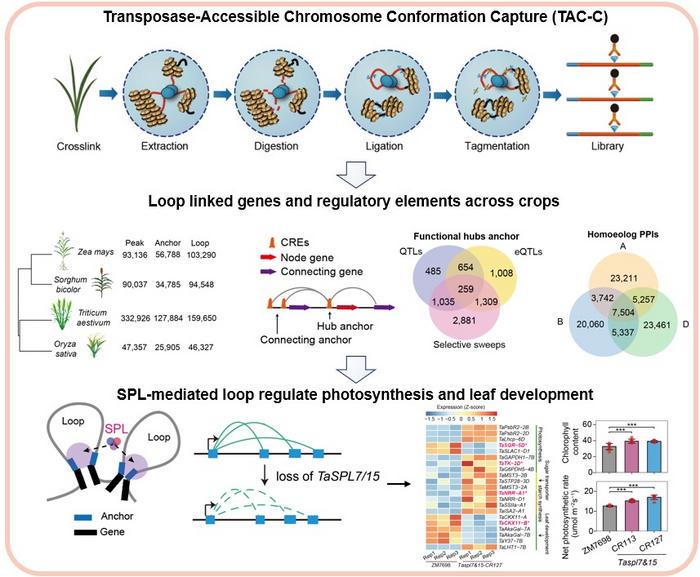
At the heart of this advancement lies a novel technique called Transposase-Accessible Chromosome Conformation Capture (TAC-C). By ingeniously combining ATAC-seq, a method that identifies open and active regions of chromatin, with the genome-wide chromatin interaction mapping capabilities of Hi-C, TAC-C offers a highly targeted and efficient approach to charting the dynamic interactions within accessible chromatin regions. This method significantly overcomes the challenges that have limited previous tools like Hi-C, ChIA-PET, HiChIP, and OCEAN-C, which often grappled with low resolution, high costs, and bias in detecting active interactions.
The structure of chromatin within plant nuclei is far from arbitrary. Instead, it is intricately folded into a complex 3D configuration that governs essential biological functions by regulating gene expression patterns. Yet, despite its importance, the specific mechanisms that sculpt and sustain this spatial genome organization, and how these structures influence functional genomic outcomes, remained largely uncharted territory prior to this research.
Utilizing TAC-C, the researchers successfully mapped high-quality 3D chromatin interaction landscapes across four major crop species. Their comprehensive analysis revealed that genomic regions serving as interaction hubs—and thus chromatin “anchors”—are not merely structural components. These hubs correlate strongly with elevated gene expression and exhibit markedly reduced sequence variation, implying their critical regulatory role. Importantly, these anchor regions were found enriched with both quantitative trait loci (QTLs) and expression QTLs (eQTLs), which provide compelling spatial genomic evidence linking distal regulatory elements to their target genes, thereby influencing complex agronomic traits and phenotypic diversity.
One of the most intriguing discoveries emerged in the hexaploid wheat genome, where the researchers detected asymmetrical chromatin interactions across its three subgenomes: A, B, and D. This uneven interaction pattern was driven largely by insertions of transposable elements and sequence divergence within the anchor regions. Such asymmetry has profound biological consequences, as it results in biased expression of homoeologous genes—essentially divergent expression patterns of gene copies inherited from different ancestral genomes within the same species.
Chromatin loop formation in animal genomes is well-characterized and predominantly governed by the CTCF/cohesin complex. However, much less was known about the analogous regulatory frameworks in plants. This study broke new ground by identifying a significant enrichment of binding motifs for several plant-specific transcription factor families—including SBP, MYB, Dof, ERF, and GATA—at chromatin interaction anchors. Notably, chromatin loops bearing SBP-binding motifs demonstrated intensified interaction strength and preferential localization within functionally active genomic territories.
Delving deeper, the team analyzed wheat mutants deficient in two SBP transcription factors—TaSPL7 and TaSPL15—which unveiled a striking loss of chromatin loops associated with critical photosynthesis-related genes such as TaCKX11-B, TaSGR-5D, TaNRR-A1, and TaTK-2D. This disruption led to altered expression profiles of these genes, manifesting phenotypically in compromised leaf development and reduced photosynthetic efficiency. These findings highlight the pivotal role that SBP proteins play not merely as conventional transcription factors but also as architectural mediators orchestrating 3D chromatin configurations.
SBP transcription factors are uniquely plant-specific and have long been recognized for their involvement in key developmental processes, including leaf, flower, root, and fruit formation, as well as transitions between vegetative and reproductive growth phases. The current research suggests an expanded functional dimension for these factors, wherein their binding activity modulates chromatin architecture to finely tune gene expression programs necessary for photosynthesis and overall plant development.
The implications of these findings extend beyond fundamental science, offering valuable insights for agricultural biotechnology. By elucidating how long-range chromatin interactions govern critical gene networks, TAC-C technology opens new avenues for precision breeding and genetic engineering aimed at crop improvement. Understanding 3D genome folding and its regulatory underpinnings equips researchers with the tools to manipulate gene expression spatially and temporally, potentially enhancing traits such as photosynthetic capacity, yield, and stress resilience.
Moreover, TAC-C demonstrates several practical advantages over existing techniques, including enhanced resolution and cost-effectiveness due to its targeted nature. This enables researchers to achieve deep insights without necessitating prohibitively deep sequencing, thus democratizing access to advanced genome architecture studies across diverse plant species. The versatility and efficiency of TAC-C position it as a transformative platform in plant genomics research.
In summary, this landmark study illuminates the sophisticated interplay between 3D chromatin architecture and gene regulation in plants, specifically underscoring the role of SBP transcription factors in mediating photosynthesis through spatial genome organization. The insights offered are poised to catalyze further research into the molecular mechanisms underpinning plant development and open promising pathways for enhancing crop productivity and sustainability through genome architecture-informed approaches.
Subject of Research:
Not applicable
Article Title:
TAC-C uncovers open chromatin interaction in crops and SPL-mediated photosynthesis regulation
News Publication Date:
30-May-2025
Web References:
http://dx.doi.org/10.1126/sciadv.adu6565
References:
XIAO Jun et al., Science Advances, 30 May 2025, DOI: 10.1126/sciadv.adu6565
Image Credits:
IGDB
Keywords:
Plant genetics, Plant evolution, Plant gene expression, Plant genes, Plant genomes, Genetic analysis, Genetic engineering
Spiritual Care Boosts Self-Efficacy, Reduces Mothers’ Burden
Next PostNew ACS Report: U.S. Cancer Survivor Count Hits 18.6 Million, Expected to Surpass 22 Million by 2035
Related Posts

Disease Experts Collaborate with Florida Museum of Natural History to Develop West Nile Virus Forecast
New Study Reveals the Science Behind Exercise and Weight Loss
Revolutionary AI Accelerates Development of Lifesaving Therapies
Boston University Secures Major Multimillion-Dollar NIH Grant to Advance Women’s Health Research
Alliance Webinar Showcases Cutting-Edge Advances in Cancer Treatment