Certain Protective Resin Coatings Found to Harm Metal Artifacts
Certain Protective Resin Coatings Found to Harm Metal Artifacts
In the realm of archaeological preservation, the quest to protect ancient metal artifacts is as challenging as it is essential. These objects, often irreplaceable and steeped in historical significance, require precise conservation methods that maintain their structural integrity and visual clarity. Conservators have long relied on clear polymer coatings, such as acrylic resins, to shield precious metals from the ravages of time. However, emerging scientific evidence now reveals an unsettling paradox: these very coatings, intended to protect, may instead be accelerating corrosion under certain conditions.
A groundbreaking study recently published in ACS Central Science highlights the complex chemical dynamics at the interface between polymer coatings and iron-containing metals. Conducted by Rui Tian, Chao Lu, and their team, this research introduces a novel three-dimensional fluorescence imaging technique designed to detect early chemical indicators of deterioration that are otherwise invisible to conventional monitoring methods. The findings challenge the long-held assumption that current acrylic resin coatings universally safeguard archaeological metals without unintended consequences.
Polymer coatings, particularly those derived from copolymers of ethyl methacrylate and methyl acrylate, are widely used due to their advantageous properties. These materials are lightweight, transparent, and impervious to water and gases, making them apparently ideal barriers against environmental factors such as oxygen, humidity, heat, and light. In addition, their strong adhesion to diverse substrates, including metals and organic materials like waterlogged wood, has made them a cornerstone in conservation science. Yet, despite their broad application, the long-term chemical behavior of these polymers and their interaction with iron-rich metals under aging conditions has remained inadequately understood until now.
Traditional methods to assess the stability of protective coatings are fraught with limitations. Techniques such as peeling off the coating risk irrevocable damage to delicate artifacts, while other non-destructive imaging methods often lack the spatial resolution or chemical specificity to capture subtle but critical changes at the resin-metal junction. The new fluorescence imaging approach addresses these challenges by selectively illuminating carboxyl groups, chemical moieties that serve as early biomarkers of corrosion processes on iron surfaces.
In a series of carefully controlled laboratory experiments, the researchers applied a standard acrylic resin coating to freshly prepared iron samples and observed the system under ambient conditions. Initially, no fluorescence was detected, indicating the absence of early corrosion markers at the interface. However, when the researchers accelerated the aging process by exposing the coated metals to intense ultraviolet radiation and elevated temperatures for thirty continuous hours, the fluorescence intensity at the resin-metal interface began to increase noticeably after only three hours. This fluorescence signal corresponds directly to the accumulation of carboxyl groups, which are closely linked to the onset of rust formation and metal degradation.
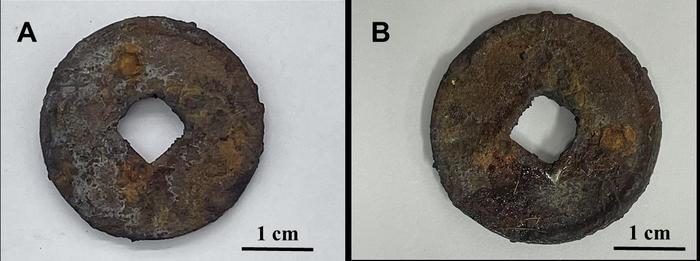
To validate their imaging technique and assess its real-world implications, the team conducted a proof-of-concept test using an authentic iron coin excavated from the Northern Song Dynasty, an artifact already exhibiting signs of surface rust. Upon coating this ancient coin with the same acrylic resin and subjecting it to accelerated aging, the researchers observed a marked intensification of fluorescence at the interface. This indicates that the polymer coating, rather than preventing further decay, was actively contributing to corrosion processes and exacerbating rust formation on an already compromised historical metal surface.
Intriguingly, when the aged polymer coating was tested on a pristine iron sample devoid of pre-existing rust or surface damage, it did not promote accelerated corrosion. This differential behavior suggests that the interaction between aged polymer coatings and iron surfaces is complex and may be influenced by the initial condition of the metal substrate. It also implies that aged polymers may be chemically incompatible with artifacts already exhibiting oxidative deterioration, raising significant concerns for conservation protocols.
At the heart of this phenomenon lies the chemical evolution of polymer coatings as they age. Under the influence of environmental stressors such as light and heat, the copolymer structure can degrade, generating acidic carboxyl groups. These groups readily interact with iron ions at the interface, facilitating the breakdown of the metal’s protective oxide layers and promoting localized corrosion. The microscopy and spectral techniques employed by Tian and colleagues have, for the first time, visualized this interfacial chemistry in three dimensions, offering unprecedented insight into conservation failures at the molecular level.
The implications of this research are profound for the field of cultural heritage preservation. Understanding that certain polymer coatings may become corrosive over time underscores the urgent need to reassess widely accepted conservation materials and methods. It also opens new avenues for the development of advanced polymers engineered with stabilizing additives and anti-aging compounds that mitigate hazardous chemical interactions. These innovations could revolutionize protective coatings, enabling them to maintain artifact integrity over extended periods without unintended side effects.
Beyond technical advancements, this study serves as a cautionary tale urging conservators, curators, and material scientists to maintain vigilance about the long-term performance of preservation materials. The use of cutting-edge, non-invasive imaging modalities like fluorescence microscopy can become an essential tool in routine artifact monitoring, allowing for early detection and intervention before irreversible damage occurs. Such proactive strategies are vital for safeguarding humanity’s shared cultural and historic legacy.
The research team acknowledges the support of the National Natural Science Foundation of China and the Beijing Natural Science Foundation, reflecting the collaborative efforts needed to tackle interdisciplinary challenges at the intersection of chemistry, materials science, and archaeology. As conservation science continues to evolve, partnerships between academic institutions and cultural heritage organizations will be indispensable in translating laboratory discoveries into practical, industry-wide standards.
While this study focuses primarily on coatings composed of acrylic resins, it sets a precedent for exploring the long-term chemical compatibility of a broader range of polymeric materials used in conservation. Holistic assessment approaches, combining aging simulations with sophisticated imaging techniques, are essential for accurately predicting the lifespan and safety of preservation treatments applied across diverse artifact materials.
In summary, the work by Tian, Lu, and their collaborators fundamentally shifts our understanding of polymer-metal interactions in the context of cultural heritage conservation. By illuminating the unexpected corrosive potential of aged polymer coatings on iron-containing metals, this research challenges prevailing assumptions and pushes the field toward more scientifically informed, effective strategies. The insights offered promise not just to preserve ancient artifacts more reliably but also to inspire novel materials innovation leveraging chemistry’s transformative power.
Subject of Research: Chemical interactions and aging effects of polymer coatings on iron-containing archaeological metal artifacts.
Article Title: Unexpected Damage on Metal Artifacts Triggered by the Hazardous Interfacial Interaction from Aging of Polymer Coatings
News Publication Date: 23-Apr-2025
Web References:
http://pubs.acs.org/doi/abs/10.1021/acscentsci.5c00067
Image Credits: Rui Tian
Keywords: Chemistry, Resins, Polymer coatings, Conservation, Corrosion, Fluorescence imaging, Iron-containing metals, Archaeological artifacts
How Attachment Shapes Panic and Separation Anxiety
Next PostProtective Resin Coatings Found to Potentially Harm Metal Artifacts
Related Posts

University of Cincinnati and Kent State University Receive $3M NSF Grant to Collaborate on Research Resource Sharing
Preparing Physicians for the Digital Era: Canadian Study Pioneers New Path in Health Education
New Study Finds US COVID-19 School Closures Ineffective Cost-Wise, While Other Non-Pharmaceutical Measures Prove Beneficial
Frontiers Honored at ALPSP Awards for Outstanding Impact on Science Education and Scholarly Publishing
Factors Shaping GP Trainees’ Supervision Decisions Revealed