
Children and amputees bear brunt of Myanmar’s deadly landmine epidemic | UN News
Myanmar has become the world’s deadliest country for landmine and unexploded ordnance casualties, with over 1,000 victims in 2023 alone, surpassing all other nations, according to separate studies by the UN Children’s Fund (UNICEF) and the International Campaign to Ban Landmines.
Children most affected
The impact of landmines and unexploded ordnance is particularly severe on Myanmar’s children, with UNICEFdata released earlier this year revealing that over 20 per cent of the 1,052 verified civilian casualties from such incidents in 2023 were children.
This was a significant rise from 2022, when 390 incidents were recorded.
Children are particularly vulnerable to landmines and unexploded ordnance (UXO), often unable to recognise their dangers.
In addition, the indiscriminate placement of these deadly weapons in and around homes, schools, playgrounds, and farming areas, puts children at constant risk.
Victims facing criminalisation
The consequences for landmine victims extend beyond physical injuries.
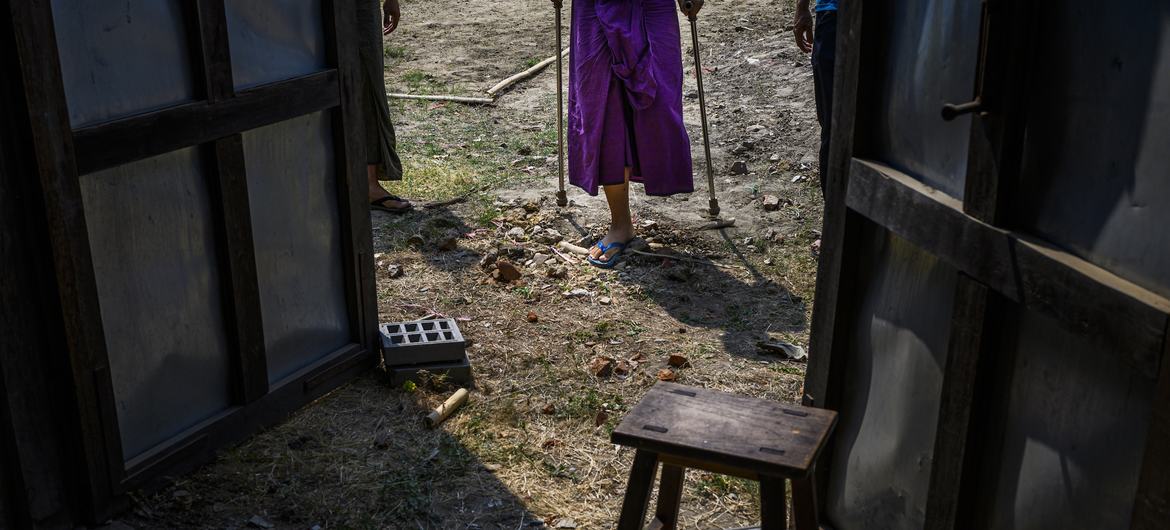
Amputees, already grappling with life-altering trauma, are being criminalised by the junta, which associates missing limbs with resistance activity.
“Now amputees are being forced into hiding to avoid harassment and arrest. Losing a limb is being seen as evidence of a crime,” the experts said.
Reality far worse
Amidst the dire picture, the reality is even worse for landmine victims and their families.
“I was heartbroken talking with a young woman who had lost her leg after stepping on a landmine near her home,” Mr. Andrews said.
“But I was infuriated when her doctor told me that she had no hope of securing a prosthesis because junta forces were blocking access to the materials necessary to build one,” he added.
Call for action
Mr. Andrews and Ms. Hagrass urged UN Member States to take coordinated measures to weaken the military junta’s ability to harm civilians.
They also called on all parties to the conflict in Myanmar to immediately stop laying landmines and begin removing them without delay.
Special Rapporteurs are independent human rights experts, appointed by the UN Human Rights Council as part of its Special Procedures. They are mandated to monitor and report on specific thematic issues or country situations and work on a voluntary basis.
They serve in their individual capacity, are not UN staff and do not receive a salary.

