Chinese–American Research Team Led by Dr. Hu Han and Dr. Jingmai O’Connor Uncovers New Findings at IVPP and Field Museum
Chinese–American Research Team Led by Dr. Hu Han and Dr. Jingmai O’Connor Uncovers New Findings at IVPP and Field Museum
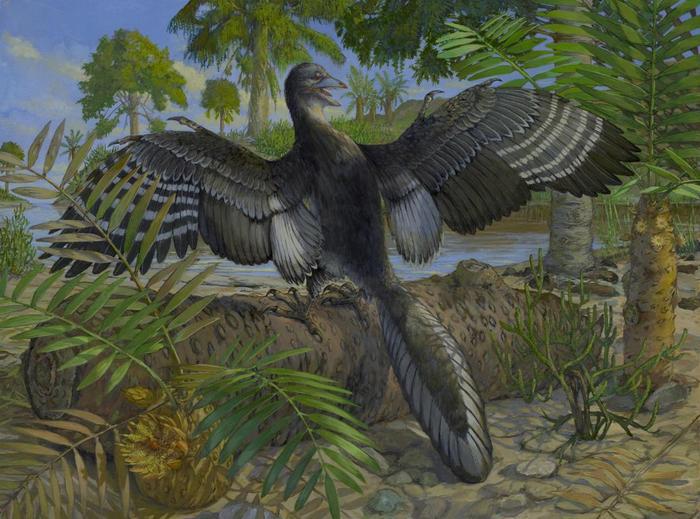
In a groundbreaking collaboration between Chinese and American scientists, a remarkable new specimen of Archaeopteryx has been uncovered, ushering in a transformative era in the study of avian evolution. This 14th known example, dubbed the Chicago Archaeopteryx, represents the smallest and arguably the most well-preserved fossil of this iconic early bird lineage, offering unrivaled insights into the delicate skeletal, soft tissue, and feather anatomy that define the evolutionary transition from non-avian dinosaurs to modern birds.
Unearthed from the Solnhofen limestone of Germany and meticulously acquired by Chicago’s Field Museum in 2022, the Chicago Archaeopteryx is roughly pigeon-sized and preserves much of its anatomy in near-three-dimensional form. This unprecedented preservation extends beyond bones to include soft tissues such as skin, toe pads, and feathers, which are rarely conserved in fossils of this antiquity. Employing cutting-edge technology such as high-resolution computed tomography (CT) scanning combined with sophisticated 3D digital reconstructions, researchers have been able to penetrate the veil of deep time with extraordinary clarity, revealing anatomical features that were previously shrouded in obscurity.
Central to the significance of this specimen is its exquisitely preserved skull, which has been digitally reconstructed to expose an intact palatal architecture. The detailed morphology of the palatal region places the Chicago Archaeopteryx in an evolutionary intermediate stage between troodontid theropods, known for their less kinetic and more rigid skulls, and more derived Cretaceous birds that exhibit increased cranial kinesis. This discovery contributes a vital piece to the puzzle of how early birds transitioned from their dinosaurian ancestors by modulating skull flexibility—a crucial adaptation thought to enhance feeding specialization and flight mechanics.
The Chicago specimen’s preserved soft tissues have also yielded surprising ecological insights. Notably, the morphology of its toe pads closely resembles those of extant ground-foraging birds rather than raptorial species. This suggests that Archaeopteryx’s locomotion was adapted for terrestrial movement, supplementing the arboreal or aerial behaviors traditionally ascribed to it. Such anatomical evidence points to a mixed lifestyle, implying ecological versatility during this pivotal stage in avian evolution where flight and ground locomotion intersected.
Perhaps the most striking paleontological revelation lies in the identification of tertial feathers on the Chicago Archaeopteryx. These feathers, which connect the wing to the body along the humerus and ulna, form a continuous aerodynamic surface integral to efficient flight dynamics in modern birds. The presence of tertials in Archaeopteryx, which had not been observed in any other non-avian feathered dinosaurs, signals a critical evolutionary innovation marking the advent of powered flight. This discovery sheds new light on the functional morphology of early avian wings and underscores the importance of feather evolution in shaping flight capacity.
Methodologically, this discovery exemplifies the marriage of paleontology and advanced imaging technology. The research team leveraged state-of-the-art 3D scanning and reconstruction techniques to enable detailed biomechanical and functional interpretations of fossil morphology. This not only facilitated comprehensive anatomical studies but also opened the door to future investigations into the dynamic performance of early bird skulls and feathers, which remain challenging to interpret through traditional two-dimensional fossil impressions.
The Chicago Archaeopteryx has rewritten key chapters in the evolutionary narrative by illuminating both the structural innovations and ecological strategies of early birds. Its well-preserved soft tissue structures allow inferences about behavior and habitat use, while the refined skeletal details provide a scaffold for reconstructing the biomechanics of flight and feeding in one of the earliest avian forms. This dual advance underscores the complex interplay between morphology and ecology during the dawn of bird evolution.
As a flagship specimen, the Chicago Archaeopteryx also highlights the profound value of international scientific collaboration. With leading researchers from the Chinese Academy of Sciences and the Field Museum working in concert, this project exemplifies how interdisciplinary approaches can accelerate discovery in vertebrate paleontology. Such teamwork is essential not only for accessing and analyzing rare specimens but also for integrating diverse expertise in anatomy, imaging technology, and evolutionary biology.
The implications of these findings extend beyond Archaeopteryx itself, framing broader questions about the evolutionary pathways that produced modern avian diversity. The intermediate cranial features, the ground-adapted toe pads, and the presence of tertial feathers collectively hint at a scenario in which early birds experimented with different locomotor and ecological strategies before the rise of fully modern avifauna in the Late Cretaceous.
Published in the prestigious journal Nature in May 2025, this study is set to become a cornerstone reference for paleontologists, evolutionary biologists, and ornithologists alike. The high-resolution CT datasets and reconstructed models provide a rich resource for ongoing comparative studies and functional analyses, potentially inspiring fresh hypotheses regarding the timing and mechanics of flight-related adaptations.
Supported by the National Natural Science Foundation of China, this research not only enriches our understanding of a charismatic fossil but also demonstrates the transformative power of technological innovation in unraveling the complexities of deep-time biology. As scientists continue to probe the fossil record with ever-more sophisticated tools, specimens like the Chicago Archaeopteryx offer a tantalizing glimpse into the origins of one of the most successful vertebrate lineages on Earth.
In conclusion, the Chicago Archaeopteryx stands as a landmark discovery that bridges morphology, technology, and evolutionary insight. It solidifies Archaeopteryx’s role as a pivotal taxon in the evolution of flight, providing tangible evidence for the gradual acquisition of avian traits while emphasizing the ecological adaptability of early birds. This specimen redefines our perception of the “first bird” and sets a new standard for the integration of paleontological data with cutting-edge imaging techniques, heralding a new phase in the scientific quest to understand the emergence of avian life.
Subject of Research: Evolution of Archaeopteryx; Early Avian Morphology and Ecology
Article Title: Discovery and Reconstruction of the Chicago Archaeopteryx: Insights into Skull Evolution and Flight Adaptations
News Publication Date: May 2025
Web References: 10.1038/s41586-025-08912-4
Image Credits: Image by O’Connor et al., Nature
Keywords: Evolution, Paleontology, Archaeopteryx, Avian Flight, Fossil Soft Tissues, CT Scanning, 3D Reconstruction, Skull Evolution, Feather Morphology
3-Year Case Management Cuts Early Psychosis Relapse
Next PostEnzyme Recognized as Key Tumor Suppressor in T-Cell Lymphomas
Related Posts

New Research Reveals Early “Inherence” Bias in the History of Science
NIH Awards $8.6 Million Grant to Renew Rare Disease Clinical Research Network for Neurodevelopmental Studies
Can Microbes Be Heroes? New Study Uncovers Hollywood’s Overlooked Microbial Story
The Science of Sacrifice: Exploring How Altruism and Evolution Collaborate
Rethinking Genetics: Why Classic Dominant-Recessive Gene Models Might Be Oversimplified