Chirality Drives Massive Charge Rectification in Superconductors
Chirality Drives Massive Charge Rectification in Superconductors
In a groundbreaking development that bridges the realms of quantum physics and molecular chemistry, researchers from the Institute for Molecular Science (IMS) and SOKENDAI have unveiled unprecedented insights into the behavior of electrons in chiral organic superconductors. Their findings reveal a surprisingly robust nonreciprocal transport phenomenon deeply intertwined with the elusive Chirality-Induced Spin Selectivity (CISS) effect, challenging conventional paradigms about spin-charge coupling in low-spin-orbit coupling materials.
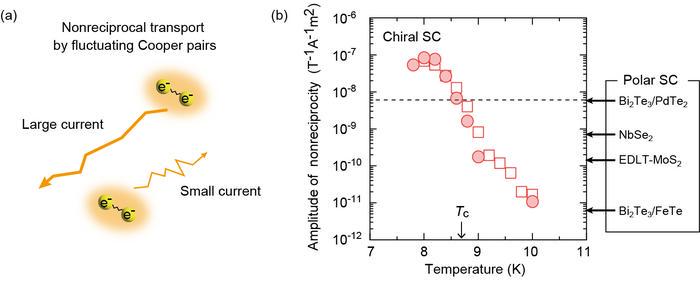
At the heart of this discovery lies the chiral organic superconductor κ-(BEDT-TTF)₂Cu(NCS)₂, commonly known as κ-NCS. This material, structured with inherent chiral symmetry, has been a subject of fascination due to its unique electronic and superconducting properties. Unlike typical polar inorganic superconductors which rely on heavy elements to amplify spin-orbit interactions, κ-NCS is composed solely of light elements such as carbon, hydrogen, nitrogen, and sulfur. This composition traditionally suggested weak spin-orbit coupling, yet experiments have revealed an exceptionally large nonreciprocal transport magnitude that today’s theories cannot satisfactorily explain.
Nonreciprocal transport refers to the phenomenon where electrical conduction depends on the direction of current flow—essentially a form of rectification at the quantum level in bulk materials. Historically, this effect has been intimately linked to the presence of strong spin-orbit coupling in materials lacking spatial inversion symmetry, often seen in polar crystalline superconductors containing heavy elements. The pronounced signals observed in κ-NCS, despite its organic and light-element nature, point toward a fundamentally different mechanism rooted in the material’s chiral geometry.
It is well-established that chirality—the property of an object being non-superimposable on its mirror image—induces a remarkable coupling between an electron’s spin and its momentum. This coupling forms the theoretical basis of the CISS effect, where electrons traversing chiral molecules experience significant spin polarization. However, attempts to quantitatively link CISS with measurable spin currents in bulk materials have been hindered by experimental challenges and the absence of comprehensive microscopic models.
By focusing on thin-film devices fabricated from κ-NCS, the research team succeeded in precisely probing these nonreciprocal transport phenomena in the superconducting regime. Utilizing sensitive electrical measurements, they detected a giant nonreciprocal signal that greatly surpasses those recorded in inorganic polar superconductors. This unexpected result implies that chirality, beyond merely imposing geometric constraints, profoundly modifies the electronic ground state, effectively enhancing spin-orbit coupling interactions to levels not predicted by standard band theory.
Their theoretical advancements provide an elegant explanation for this anomaly. The researchers propose that chirality fosters a mixing between spin-singlet and spin-triplet Cooper pairs—paired electrons responsible for superconductivity—with the latter playing a crucial role in magnifying the spin-current coupling. This mixed pairing state deviates from conventional models, which generally consider only spin-singlet states in organic superconductors with weak spin-orbit forces. The emergence of spin-triplet components reflects a novel quantum mechanical intertwining of spin and momentum, rooted directly in the chiral lattice structure.
Further deepening the implications of their work, the team explored the superconducting diode effect—a phenomenon where the critical current in a superconductor exhibits directional dependence, effectively acting as a superconducting rectifier. Remarkably, κ-NCS achieved a diode efficiency approaching 5%, a figure on par with the earliest observations in inorganic polar superconductors containing heavy atoms. This parity underscores the practical potential of chiral organic materials in designing low-energy superconducting components capable of highly directional current flow.
From a broader perspective, these findings illuminate the general role of symmetry and molecular structure in manipulating spin-related quantum phenomena. The confluence of chirality and superconductivity introduces a new avenue to engineer materials with distinctive spin-momentum locking properties, paving the way for advanced spintronic applications and quantum devices. Unlike conventional strategies that rely heavily on elemental composition, the IMS team’s work opens the door to tailoring electronic behaviors through geometric and topological design.
The research clarifies long-standing mysteries surrounding the CISS effect in organic molecules by providing a robust, experimentally validated framework grounded in crystalline superconductors. The ability to quantify spin-current coupling in these systems offers a powerful tool for physicists and chemists alike, fostering interdisciplinary synergy to exploit chirality for technological advancement.
Looking ahead, this breakthrough invites an expansion of research into diverse chiral materials and superconducting architectures. The exploration of two-dimensional organic superconductors with nontrivial spin textures could revolutionize the landscape of quantum materials, leading to novel functionalities such as dissipationless spin current channels, ultra-sensitive magnetic sensors, and scalable quantum bits for computation.
Moreover, the successful integration of chirality-inspired mechanisms into practical devices hints at transformative applications beyond fundamental science. These include energy-efficient superconducting circuits, low-noise signal rectifiers, and next-generation spintronic components operative at high speeds and low power consumption. The impact spans from fundamental condensed matter physics to potential industry breakthroughs in quantum computing and electronic engineering.
Published in the American journal Physical Review Research in April 2025, this pioneering study, led by Takuro Sato, Hiroshi Goto, and Hiroshi M. Yamamoto, underscores the intricate quantum dance of electrons influenced by their host’s molecular handedness. It is a testament to the profound possibilities residing at the intersection of chirality, superconductivity, and spintronics, heralding a new era of research that reshapes our understanding of electron transport in organic materials.
By unveiling sturdy spin-momentum locking enabled by chiral symmetry, this work challenges the scientific community to rethink the fundamental limits of spin-charge interactions and to explore the untapped potential held by light-element superconductors. As investigations proceed, the principles uncovered here are expected to inspire novel theoretical frameworks and inspire innovative experimental pursuits that may one day bring chiral superconductors to the forefront of quantum technology.
Subject of Research: Not applicable
Article Title: Sturdy spin-momentum locking in a chiral organic superconductor
News Publication Date: 15-Apr-2025
Web References:
10.1103/PhysRevResearch.7.023056
References:
Sato, T., Goto, H., & Yamamoto, H. M. (2025). Sturdy spin-momentum locking in a chiral organic superconductor. Physical Review Research, 7(2), 023056.
Image Credits: Takuro Sato
Keywords
Chirality, CISS effect, Nonreciprocal transport, Organic superconductor, Spin-orbit coupling, Spin-triplet Cooper pairs, Spin-momentum locking, Superconducting diode effect, κ-(BEDT-TTF)₂Cu(NCS)₂, Quantum materials, Spintronics, Bulk charge rectification
Study Finds Nature-Based Activities Effective in Treating Anxiety and Depression
Next PostSNMMI LBCA Fellowship for Invasive Lobular Carcinoma Research Awarded to Dr. Randy Ye by Mars Shot Fund
Related Posts

Wiley Enhances Knowitall Solutions with Trendfinder App for Intuitive Chemometric Analysis and Improved Analytical Workflows
In-Situ Molecular Passivation Boosts Pure-Blue Perovskite LEDs Through Vacuum Thermal Evaporation
Researchers Identify Crucial Role of Small Molecules in Stabilizing Biological Systems
Assessing Liquefaction Resistance in Chemically Treated Soils Using Cyclic Triaxial Testing
Random-Event Clocks Offer New Window into the Universe’s Quantum Nature