Compact High-Resolution Metalens Doublet Microscope Advances Biomedical Imaging
Compact High-Resolution Metalens Doublet Microscope Advances Biomedical Imaging
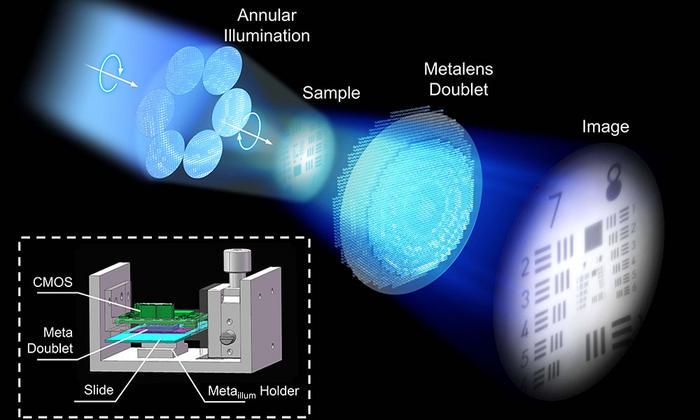
In a groundbreaking advancement poised to reshape the future of optical microscopy, researchers from Nanjing University have unveiled a novel metalens-based microscope design that simultaneously achieves exceptional resolution and a wide field of view (FOV). This accomplishment addresses one of the most stubborn challenges in the integration of metalenses into practical imaging systems: overcoming off-axis aberrations without compromising resolution or compactness. Metalenses, composed of nanoscale structures that precisely manipulate light at subwavelength scales, offer a radical departure from traditional curved glass optics, yet their widespread adoption in microscopy has been hindered by intrinsic limitations in field coverage and image clarity.
Conventional microscope objectives rely on thick, curved lenses made from glass to focus light, which inevitably introduces size and weight constraints. In contrast, metalenses employ engineered metasurfaces patterned with arrays of nano-fins, enabling ultrathin, flat optical elements that can bend and shape light wavefronts with unprecedented control. This miniaturization potential is vital for integrating microscopy into handheld, portable, or even embedded devices, promising substantial innovation across biomedical diagnostics, environmental monitoring, and advanced manufacturing.
Despite these advantages, metalenses have historically struggled with off-axis aberrations—optical distortions that degrade image quality toward the edges of the field. This phenomenon has forced designers into a trade-off: achieving high resolution demands a narrow FOV, while expanding the FOV typically sacrifices image sharpness. Previous metalens implementations managed to reach submicron spatial resolution but were accompanied by severely limited viewing areas, rendering them impractical for comprehensive biological or material inspection tasks where large samples or heterogeneous tissues require simultaneous visualization.
The researchers’ innovative approach harnesses a monolithic doublet configuration consisting of two metalenses fabricated on opposing faces of a transparent silica substrate. Each metalens is composed of high-aspect-ratio silicon nitride nano-fins meticulously arranged in square patterns with precise dimensional tuning. This configuration, combined with an annular illumination scheme generated by metasurfaces embedded within the system architecture, effectively mitigates off-axis aberrations. The annular illumination selectively channels light in a ring-shaped pattern, which reduces aberrations and enhances contrast across the entire imaging plane.
This breakthrough design has propelled metalens microscopy into new performance regimes. The team’s prototype achieves a field of view up to 150 micrometers paired with a half-pitch resolution as fine as 310 nanometers—a metric that surpasses the sharpest resolutions demonstrated to date in meta-optical microscopy. Dr. Tao Li, the study’s corresponding author, emphasizes that this resolution-FOV balance moves metalens applications closer to rivaling high-end conventional optics, but in a dramatically reduced form factor.
To validate the design’s practicality beyond laboratory conditions, the researchers built an integrated prototype measuring a mere 4 centimeters by 4 centimeters by 5 centimeters, weighing a fraction of typical microscopes. Despite its diminutive size, it delivered a 1-millimeter-wide FOV with 620-nanometer resolution, demonstrating scalability toward real-world usage. The compact system leverages metasurface-based optics not only for image formation but adeptly integrates annular illumination without bulky ancillary components, signaling a new era of all-in-one, flat optical devices compatible with portable platforms.
A compelling demonstration involved imaging cervical cancer cells, where the meta-microscope captured detailed biological features across various stages of malignancy within a single field. Cellular characteristics such as nuclear enlargement, deformation patterns, and mitotic figures were distinctly resolved, underscoring the system’s potential for high-throughput medical diagnostics. This wide-field capability allows pathologists to comprehensively examine heterogeneous tissue samples, affording enhanced diagnostic accuracy that was previously unattainable with metalens-based systems.
The implications of this technology are vast and multi-disciplinary. In settings where portability is paramount—such as remote clinics, field research stations, or mobile laboratories—this metalens microscope could deliver cutting-edge imaging capabilities without the logistical burdens of conventional equipment. Moreover, the prospect of embedding such systems into wearable devices or microelectronic platforms hints at revolutionary pathways for real-time biological monitoring, automated clinical workflows, and environmental sensing.
From an engineering standpoint, the successful synthesis of high-resolution and wide-field imaging in a monolithic meta-doublet marks a significant milestone in metasurface optics. It overcomes longstanding design conflicts by carefully balancing the metasurface parameters—size, spacing, and height of nano-fins—while employing innovative illumination techniques that optimize wavefront propagation. Such methods could inspire analogous advancements across other meta-optical devices, including compact cameras, LiDAR systems, and augmented reality components.
The researchers’ vision extends beyond miniaturization: they aim to catalyze the next generation of optical instrumentation that combines performance on par with traditional glass optics and the agility demanded by modern applications. By delivering a scalable, integrated solution that negates bulky lenses without compromising image fidelity, their metalens doublet platform opens unprecedented opportunities in both fundamental science and applied technology.
Looking forward, this work establishes a foundational framework for further enhancing metalens functionality. Prospects include widening spectral bandwidths, improving fabrication tolerances, and integrating multifunctional metasurfaces. Such enhancements will be critical for expanding the range of applications, including multispectral imaging, live-cell microscopy, and high-speed data acquisition in compact formats.
In conclusion, the marriage of monolithic metalens doublets with annular illumination represents a paradigm shift in optical microscopy, breaking free from the size and performance constraints that have traditionally limited metalens utility. This innovation presents a compelling case for why meta-optical devices will become cornerstones in future imaging technologies, delivering unmatched resolution, wide-field perspectives, and compactness. The advancements from Nanjing University shine a spotlight on the transformative power of metasurface design in overcoming optical challenges once deemed insurmountable.
Subject of Research: Metalens-based microscopy integrating monolithic meta-doublets with annular illumination to achieve high-resolution wide-field imaging
Article Title: High-resolution and wide-field microscopic imaging with a monolithic meta-doublet under annular illumination
News Publication Date: 27-May-2025
Web References:
https://www.spiedigitallibrary.org/journals/advanced-photonics/volume-7/issue-04/046006/High-resolution-and-wide-field-microscopic-imaging-with-a-monolithic/10.1117/1.AP.7.4.046006.full
References:
Sun, J., Shen, W., Wang, J., et al., “High-resolution and wide-field microscopic imaging with a monolithic meta-doublet under annular illumination,” Advanced Photonics, 7(4), 046006 (2025). DOI: 10.1117/1.AP.7.4.046006
Image Credits: Tao Li and Jiacheng Sun (Nanjing University)
Keywords
Imaging, Observational studies, Optics, Biomedical engineering, Health and medicine, Microscopy, Environmental impact assessments
New Study Reveals Health Risks Associated with Ultrasonic Cigarettes
Next PostDecoding Cancer’s Secret Language: The SOLFEGE Project Unveils Cell Communication Mysteries
Related Posts

Quantum Sensors Built to Withstand Extreme Pressures
Princeton Chemistry’s Hammes-Schiffer Unveils First-Principles Method for Molecular Polaritons
Smoking or Vaping Could Elevate Your Risk of Developing Diabetes, New Study Finds
Metasurface Revolutionizes Atomic Magnetometers with Enhanced Compactness and Sensitivity
New Study Highlights the Promise of Collagen-Based Micro/Nanogels in Medical Applications