Independent Swedish study finds switch from conventional farming to organic would require 130% additional land to maintain yields


Highlights
- The distribution of crop and fodder production in organic and conventional farms is established for eight regions of Sweden.
- Regional yield per ha (mass and metabolic energy) of grain and fodder crop production is calculated for both farm types.
- Milk production is calculated for herds fed diets to maximize yield per ha of total energy of grain plus milk or of milk.
- Total regional yield of human food per ha from milk and remaining grain is estimated for both herd-feeding strategies.
- Organic Agriculture (OA)/Conventional Agriculture (CA) yield ratios of human food production range 0.43 to 0.74 across regions and are inversely related to CA yield.
Context
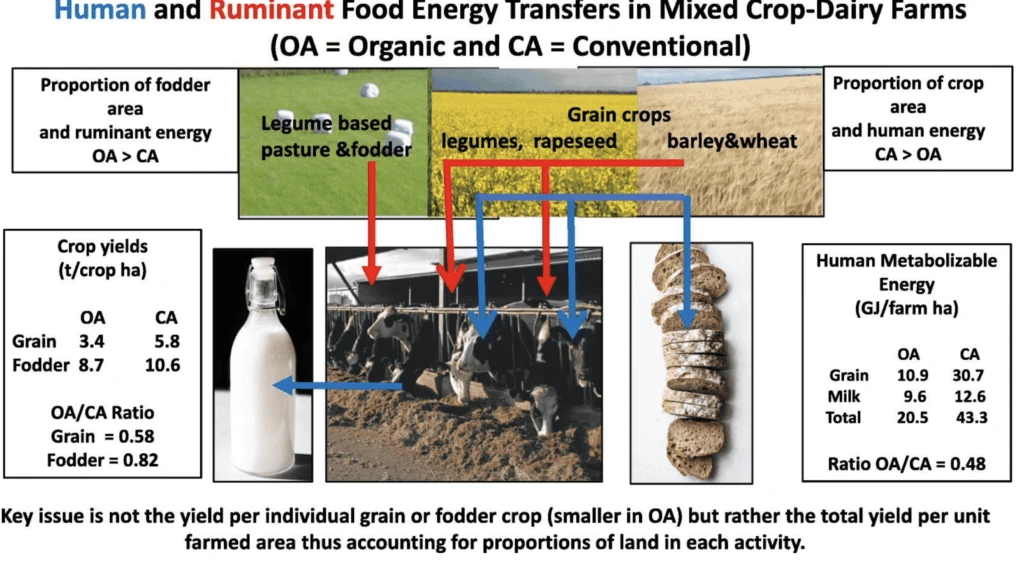
Most information on relative yield of organic (OA) and conventional agriculture (CA) is from plot experiments of individual crops grown with organic or inorganic fertilizers, respectively. Commonly reported values are 0.75–0.91, a relatively small difference. But organic manures are produced through biological nitrogen fixation(BNF) by legumes. How much and what else does that land in legumes contribute to overall yield?
Objective
Establishment of OA/CA yield ratios for crop-dairy production at regional scale accounting for proportions of land in crop and fodder production and their contributions to overall food yield using human metabolizable energy (HME) as a unifying parameter of yield of grain and milk.
 Significance
This analysis establishes smaller relative yields of OA than are commonly reported. Smaller yields per crop area in OA are further reduced at farm (system) level relative to CA by the larger proportion of land required in legume-based crops and pastures. Ruminant animals provide some compensation for that land by converting human-inedible fodder to human food. Consequently, transformation of CA farmland to OA would require additional land, up to 130% in productive southern and central regions, to maintain equal overall yield. More such comprehensive data are required for calculation of OA/CA yield ratios at the system level.
This is an excerpt. Read the original post here

 | Videos | More... |

Video: Nuclear energy will destroy us? Global warming is an existential threat? Chemicals are massacring bees? Donate to the Green Industrial Complex!
 | Bees & Pollinators | More... |

GLP podcast: Science journalism is a mess. Here’s how to fix it

Mosquito massacre: Can we safely tackle malaria with a CRISPR gene drive?

Are we facing an ‘Insect Apocalypse’ caused by ‘intensive, industrial’ farming and agricultural chemicals? The media say yes; Science says ‘no’
 | Infographics | More... |

Infographic: Global regulatory and health research agencies on whether glyphosate causes cancer
 | GMO FAQs | More... |

Why is there controversy over GMO foods but not GMO drugs?

How are GMOs labeled around the world?
How does genetic engineering differ from conventional breeding?
 | GLP Profiles | More... |

Alex Jones: Right-wing conspiracy theorist stokes fear of GMOs, pesticides to sell ‘health supplements’

 Viewpoint — Fact checking MAHA mythmakers: How wellness influencers and RFK, Jr. undermine American science and health
 Viewpoint: Video — Big Solar is gobbling up productive agricultural land and hurting farmers yet providing little energy or sustainabilty gains
 Fighting deforestation with CO2: Biotechnology breakthrough creates sustainable palm oil alternative for cosmetics
 Trust issues: What happens when therapists use ChatGPT?
 California, Washington, Oregon forge immunization alliance to safeguard vaccine access against federal undermining
 30-year-old tomato line shows genetic resistance to devastating virus
 The free-range chicken dilemma: Better for birds, but with substantial costs
 ‘You have to treat the brain first’: Rethinking chronic pain with Sanjay Gupta