Industrial Robots Transform Stroke and Spinal Rehab
Industrial Robots Transform Stroke and Spinal Rehab
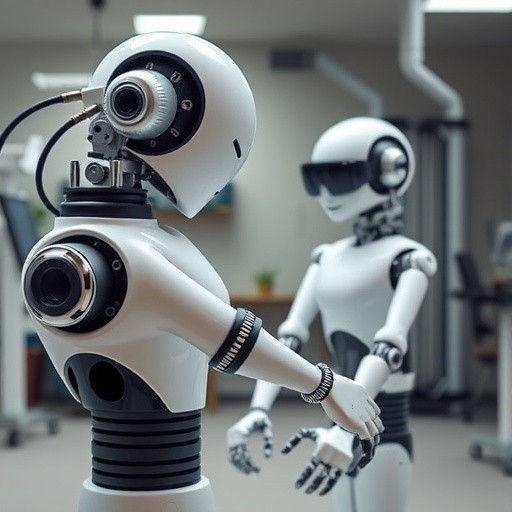
In the evolving landscape of neurorehabilitation, the integration of advanced robotics promises a transformative leap in restoring motor function after debilitating neurological injuries. A recent systematic narrative review published in BioMedical Engineering OnLine shines a spotlight on the use of industrial-grade collaborative robots—commonly referred to as cobots—in the motor rehabilitation of individuals following stroke and spinal cord injury (SCI). This comprehensive examination reveals both the cutting-edge potential of cobots and the critical gaps yet to be addressed in their application within clinical rehabilitation paradigms.
Collaborative robots represent a class of robotic systems specifically designed to operate safely alongside humans, without the need for restrictive safety cages that are typical of traditional industrial robots. Unlike custom-built rehabilitation devices, cobots leverage state-of-the-art sensors, force feedback systems, and adaptive control algorithms to dynamically respond to patient movements. This intrinsic design prioritizes safety and flexibility, making cobots particularly suitable for delicate motor rehabilitation tasks where patient variability and vulnerability are paramount concerns.
The reviewed studies collectively underscore that the use of industrial-grade cobots in rehabilitation is still nascent but rapidly gaining traction. Across 33 selected investigations, mostly focused on lower extremity therapy, cobots have been demonstrated to facilitate repetitive, task-specific motor exercises in patients recovering from stroke or SCI. These exercises target the restoration of gait, balance, and lower limb dexterity, with sensor-driven feedback loops ensuring patient safety while maximizing therapeutic intensity.
One of the most notable technical advantages of using cobots lies in their advanced sensor integration. Force sensors, position encoders, and electromyographic feedback systems allow the robot to detect real-time changes in patient movement and muscle activation. Cobots can adapt their assistance levels instantaneously, preventing excessive force or unnatural joint trajectories that could exacerbate injury. This contrasts sharply with many rehabilitation robots that operate in rigid, pre-programmed manners, thereby limiting personalized patient interaction and safety.
Despite these promising features, the review highlights a striking absence of studies targeting upper extremity rehabilitation using industrial-grade cobots. While upper limb function is critically impaired in many stroke and SCI patients—often dictating independence in daily living—the current literature predominantly explores lower limb interventions. This suggests both a technological challenge in designing cobots with the dexterity and delicacy required for upper extremity tasks and a research gap that future investigations must urgently address.
The user experience dimension is another key theme emerging from the literature. Patients engaged with cobot-assisted rehabilitation reportedly experience positive motivational effects, owing largely to the immediate and responsive feedback that these robots provide. This not only boosts adherence to intensive therapy regimens but could potentially enhance neural plasticity mechanisms underpinning functional recovery. The human-robot interaction thus extends beyond mere physical assistance, weaving cognitive and emotional engagement into the rehabilitation process.
From a clinical standpoint, the seamless integration of cobots could revolutionize therapist workflows. By automating repetitive tasks with precise control and safety monitoring, cobots enable clinicians to allocate their expertise toward more strategic decision-making and personalized therapy planning. Furthermore, the inherent collaborative capabilities of these robots support a hybrid model of care, balancing human intuition with robotic consistency.
Nonetheless, the review makes clear that robust empirical data supporting cobot efficacy remain sparse. Most studies are preliminary, involving small cohorts and short intervention durations, leaving critical questions about long-term functional outcomes unanswered. Variables such as optimal training dosage, protocol standardization, and cost-effectiveness require rigorous evaluation through large-scale clinical trials to validate clinical implementation.
Technological refinement is equally essential to extend cobot utility beyond controlled laboratory environments into diverse, real-world rehabilitation settings. Developing modular systems that can seamlessly switch between assisting upper and lower limbs, and incorporating machine learning algorithms capable of personalizing therapy based on real-time performance metrics, represent promising avenues of exploration.
Moreover, the review recognizes that achieving widespread adoption will also depend on ergonomic design advancements. Cobots must become intuitively operable by clinicians with minimal training and adaptable to the heterogeneous needs of patients across various recovery stages and severities.
Looking ahead, the synergy between advanced industrial robotics and neurorehabilitation holds immense promise. By harnessing the precision, adaptability, and safety of collaborative robots, we stand on the cusp of a new era where rehabilitative care is more effective, efficient, and accessible. Such innovation could fundamentally shift the rehabilitation paradigm—moving from passive recovery to active, patient-centered restoration of motor function.
In conclusion, while industrial-grade collaborative robots are poised to disrupt motor rehabilitation post-stroke and SCI, translating this promise into tangible clinical benefits demands interdisciplinary collaboration. Engineers, clinicians, and researchers must jointly navigate the complex interface of robotics technology and human physiology to unlock the full therapeutic potential of cobots. As the field matures, enriched by ongoing research and technological breakthroughs, these robots may well become indispensable partners in rebuilding lives touched by neurological injury.
—
Subject of Research:
Article Title: Industrial-grade collaborative robots for motor rehabilitation after stroke and spinal cord injury: a systematic narrative review
Article References: Raji, A., Gopaul, U., Babineau, J. et al. Industrial-grade collaborative robots for motor rehabilitation after stroke and spinal cord injury: a systematic narrative review. BioMed Eng OnLine 24, 50 (2025). https://doi.org/10.1186/s12938-025-01362-z
Image Credits: AI Generated
DOI: https://doi.org/10.1186/s12938-025-01362-z
Keywords: collaborative robots, cobots, motor rehabilitation, stroke, spinal cord injury, neurorehabilitation, robotic therapy, user safety, sensor integration, human-robot interaction
Boosting Prison Healthcare: Effective Capacity-Building Strategies
Next PostFrom STEM Ecosystems to Markets: Rethinking Learning Connections
Related Posts

Navigating Conscience in Elder Care: A Deep Dive
Magnetic Sensor Tracks Endotracheal Tube Position
Hair Reveals Clues: Unraveling Children’s Mental Health Through Strand Analysis
Mediterranean Diet Linked to Reduced Risk of Gum Disease
PSQI Scores, Body Composition, and T2DM Insights