Innovative Trinity Teaching Model Based on MOA Framework: Insights from Wuhan University’s Internet Marketing Course
Innovative Trinity Teaching Model Based on MOA Framework: Insights from Wuhan University’s Internet Marketing Course
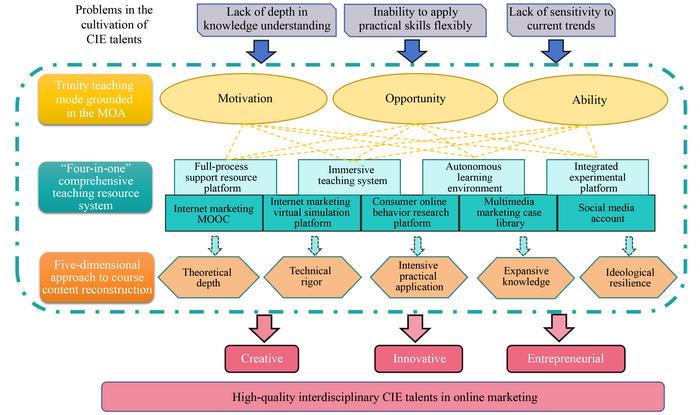
In an era profoundly shaped by the digital economy, higher education faces an urgent imperative: to cultivate talents not merely equipped with knowledge but imbued with creativity, innovation, and entrepreneurial spirit. At the forefront of this transformative wave, Wuhan University has pioneered a groundbreaking teaching model tailored specifically for its Internet Marketing course. This model, deeply rooted in the MOA (motivation, opportunity, ability) framework, seeks to overhaul conventional pedagogical approaches that have long struggled to meet the demands of a rapidly evolving digital marketplace.
Traditional higher education teaching methods often overlook the nuanced interplay between motivation, opportunity, and ability, resulting in disengaged students who lack intrinsic drive. Wuhan University’s research identified critical deficits, particularly in motivation, where teaching fails to resonate with student interests, thereby stifling enthusiasm for learning. From an opportunity standpoint, the existing curriculum rarely integrates real-world emerging trends, limiting experiential learning that connects theoretical concepts to practical application. Further compounding this issue, the traditional model inadequately cultivates students’ abilities in self-directed learning and innovation, factors increasingly essential for success in digital industries.
Recognizing these shortcomings, the team at Wuhan University developed an innovative trinity teaching mode that operationalizes the MOA framework within a cohesive pedagogical structure. This approach meticulously integrates three core dimensions: the motivation dimension emphasizes student engagement through diverse assignments and peer-feedback mechanisms, fostering an environment where learners become active participants rather than passive recipients of knowledge. The opportunity dimension leverages a sophisticated “four-in-one” platform that amalgamates full-process pedagogical support, immersive teaching experiences, autonomous learning capabilities, and integrated experimental environments to create multifaceted learning opportunities. Finally, the ability dimension strategically focuses on nurturing students’ comprehensive innovative capabilities, equipping them with skills that transcend rote memorization to include critical thinking, creativity, and entrepreneurial mindset.
Central to this new paradigm is the “four-in-one” teaching resource system, a robust infrastructure that underpins the entire learning journey. Full-process support resources are meticulously designed to scaffold five progressive learning stages: cognitive learning, simulated practice, application enhancement, knowledge expansion, and outcome presentation. These stages collectively ensure a seamless transition from foundational comprehension to applied expertise and finally to demonstrable output. Immersive teaching techniques, enhanced by cutting-edge technologies, further deepen student engagement, offering experiential learning scenarios that mirror real-world digital marketing challenges. Autonomous learning, meanwhile, empowers students with the agency to chart personalized educational trajectories, adapting to individual paces and interests—a feature rarely feasible in conventional lecture-centered formats.
In reconstructing the Internet Marketing course content, fidelity to the MOA framework demanded a multidimensional overhaul. The curriculum evolved to exhibit greater theoretical depth, rigorous technical content, intensified practical application, expansive knowledge coverage, and reinforced ideological resilience. Such a composite curriculum challenges students intellectually while grounding them in the realities of digital marketing’s dynamic landscape. The teaching evaluation process similarly underwent reform, transitioning from conventional exams to innovative peer-based assessments and differentiated assignments. This not only aligns evaluations more closely with practical skill acquisition but also embeds ideological education, fostering socially responsible digital marketers attuned to ethical considerations within the industry.
The empirical efficacy of Wuhan University’s trinity teaching mode has been validated through an experimental study, revealing remarkable outcomes. Student satisfaction rates soared, and demonstrable improvements were observed in employability metrics, signaling the model’s alignment with industry expectations. Furthermore, graduates immersed in this pedagogy showcased exceptional performance in competitive arenas, including graduate school admissions and marketing contests, establishing the teaching mode not just as a theoretical innovation but as a practical blueprint for educational reform.
This innovative educational framework’s relevance transcends Wuhan University, offering a template adaptable to diverse academic disciplines grappling with evolving digital realities. By centering the interplay of motivation, opportunity, and ability, educators can recalibrate curricula and teaching methods to foster innovation and entrepreneurship intrinsically rather than as ancillary objectives. The “four-in-one” platform, in particular, exemplifies a scalable technological solution that accommodates the technical rigour and interdisciplinary breadth necessary in contemporary higher education.
Moreover, Wuhan University’s endeavor illustrates the critical role of integrated teaching evaluation methodologies in modern pedagogy. Moving beyond standardized testing, embedding peer review and project-based assessment fosters collaborative learning and critical reflection, essential components in nurturing creative problem-solving abilities. This paradigm shift underscores the growing recognition that assessment shapes learning behaviors and must evolve hand-in-hand with curriculum innovation.
Technological advancements further magnify the potential of such a trinity teaching mode. Immersive technologies such as virtual reality and simulation-based learning environments, encompassed within the “four-in-one” platform, facilitate authentic experiential learning. These tools recreate complex marketing scenarios, enabling students to experiment in risk-free settings and thus bridge the often-cited gap between theory and practice. Autonomous learning modules augment this process by providing customizable pathways, addressing the heterogeneous learning needs prevalent in contemporary classrooms.
From a broader educational policy perspective, the success of Wuhan University’s model provides impetus for systemic reforms focused on nurturing digital economy competencies. Institutions worldwide are challenged to rethink their pedagogical models amid accelerating technological change and shifting labor market demands. This trinity teaching mode lays a foundational example, demonstrating how theoretical educational frameworks, when operationalized through technology-enhanced pedagogy, can yield tangible improvements in talent cultivation.
Finally, the ideological resilience embedded within the curriculum ensures that digital marketing education does not become a mere technical exercise but encompasses ethical reflections, social responsibility, and sustainable innovation. Such considerations are vital in an age where digital platforms wield enormous cultural and economic influence, and marketers play crucial roles in shaping consumer behavior and public discourse.
Wuhan University’s article, titled “A Trinity Teaching Mode Grounded in the MOA Framework: Insights from Wuhan University’s Internet Marketing Course,” published in Frontiers of Digital Education on March 20, 2025, stands as a landmark contribution to digital pedagogy literature. It offers a meticulously theorized and empirically tested methodology that promises to inspire educators, curriculum designers, and policymakers committed to fostering the next generation of innovators and entrepreneurs poised to thrive in a digital world.
Subject of Research: Not applicable
Article Title: A Trinity Teaching Mode Grounded in the MOA Framework: Insights from Wuhan University’s Internet Marketing Course
News Publication Date: 20-Mar-2025
Web References: http://dx.doi.org/10.1007/s44366-025-0049-8
Image Credits: Minxue Huang, Yangyi (Eric) Tang, Yuan Liu, Qiyuan Wang
Keywords: Information science
Limited Healthcare Access for Pregnant Individuals and Infants in U.S. Communities Vulnerable to Wildfire Smoke
Next PostAttempts to Curb TikTok Screen Time May Actually Boost Usage, Study Finds
Related Posts

How Name, Image, and Likeness (NIL) Rights Enhance Competitive Equilibrium in College Football
Highlighting Exercise Science in Pre-Menopausal Women
Future Careers: Matching Kids’ Aspirations with Jobs
University of Cincinnati and Kent State University Receive $3M NSF Grant to Collaborate on Research Resource Sharing
Preparing Physicians for the Digital Era: Canadian Study Pioneers New Path in Health Education