Microlaser Sensors Revolutionize Biosensing with Enhanced Precision
Microlaser Sensors Revolutionize Biosensing with Enhanced Precision
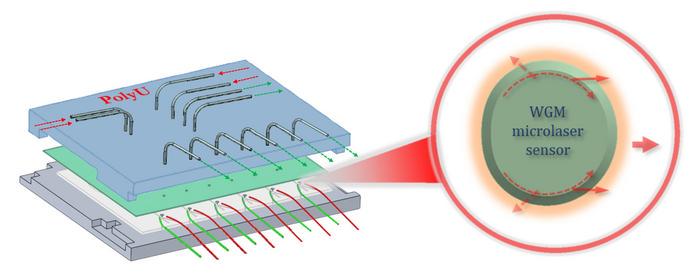
In a groundbreaking advancement poised to revolutionize early disease detection, researchers at The Hong Kong Polytechnic University have developed a novel 3D micro-printed polymer microlaser sensor, designed to seamlessly integrate within lab-on-a-chip systems. This innovation centers on a whispering-gallery-mode (WGM) microlaser utilizing a uniquely shaped Limacon microcavity, enhancing both the sensitivity and practicality of biosensing applications. With this technology, the path toward rapid, ultrasensitive diagnosis of diseases including cancer, Alzheimer’s, and viral infections appears markedly more attainable.
The core principle behind whispering-gallery-mode microlasers involves confining light within microscopic cavities, where the light resonates along the cavity’s inner surface, effectively amplifying interactions with surrounding biomolecules. This optical resonance is exquisitely sensitive to minute perturbations, such as molecular binding events, which induce subtle shifts in the laser frequency. These frequency changes provide a direct, quantitative measure of biomarker presence, laying the foundation for highly precise, label-free biosensing technologies.
Traditional implementations of these microlaser sensors, however, have been constrained by significant technical challenges. Notably, efficient excitation and readout of the lasing signal typically require coupling light into or out of the sensor via tapered optical fibers smaller than two microns in diameter. Handling and aligning such ultra-thin fibers is a painstaking process prone to environmental perturbations, thus limiting the scalability and robustness essential for point-of-care diagnostic devices.
Addressing this critical bottleneck, the team devised a Limacon-shaped microdisk as the microlaser cavity, diverging from the conventional circular designs. This asymmetric geometry inherently supports directional emission of the microlaser output, negating the need for complex fiber coupling. The directional light exits the sensor chip efficiently, making integrated on-chip detection more feasible and reliable. This shift represents a strategic breakthrough, improving the sensor’s practicality without sacrificing performance.
The fabrication of these intricately shaped microresonators was made possible through an advanced in-house 3D micro-printing technique. This additive manufacturing method offers unmatched precision and flexibility, enabling rapid prototyping and manufacturing of microscale optical structures with high spatial resolution. The ability to holistically print the whispering-gallery-mode microcavity, alongside suspended microdisks, in a single process revolutionizes sensor production, promising reduced costs and enhanced reproducibility.
Experimental demonstrations of the printed biosensors underscored their exceptional lasing characteristics. The devices exhibited an impressively low lasing threshold of just 3.87 microjoules per square millimeter, highlighting their efficient optical gain. Moreover, the lasers delivered a narrow emission linewidth on the order of 30 picometers, indicative of their coherent and stable operation—key parameters for sensitive detection in optical biosensing.
Crucially, the sensors demonstrated ultra-low detection limits, successfully identifying human immunoglobulin G (IgG) at attogram-per-milliliter concentrations. IgG, a vital antibody circulating in blood and bodily fluids, serves as a critical biomarker for immune response and numerous disease states. Detecting such minuscule quantities without the need for labeling agents elevates the device’s potential for use in rapid, minimally invasive diagnostic platforms.
The sensor’s high sensitivity combined with a streamlined on-chip format embodies an important stride toward next-generation optofluidic biochips. These chips aim to integrate microfluidics with optical sensing to allow multiplexed and quantitative analysis of various disease biomarkers in a single assay. Such integration promises not only diagnostic robustness but also significant reductions in reagent usage, assay time, and overall costs.
Looking ahead, the research team plans to embed these microlaser sensors into functional microfluidic architectures, moving closer to commercially viable lab-on-a-chip platforms. This convergence of photonics and microfluidics could accelerate the transition from bench experiments to clinic-ready devices, enabling timely and accurate disease screening at the point of care, even in resource-limited settings.
This advancement arrives amid an increasing global demand for sensitive, portable diagnostics, catalyzed by pressing health challenges such as pandemics and the rising prevalence of chronic diseases. By enhancing the sensitivity and integration capability of biosensors, this technology could empower healthcare providers with unprecedented tools for early intervention and personalized medicine.
The reported work was published in the renowned journal Optics Letters, reflecting its high impact within the photonics and biomedical optics communities. With strong backing from the Research Grants Council of Hong Kong, the project exemplifies cutting-edge innovation at the nexus of applied physics, engineering, and clinical medicine.
In summary, the development of the 3D micro-printed polymer Limacon-shaped whispering-gallery-mode microlaser sensor represents a transformative advance in the domain of label-free biosensing. Its unique optical design and manufacturing approach overcome longstanding integration hurdles, achieving ultralow biomarker detection limits critical for early disease diagnosis. The fusion of optical microcavities and microfabrication technology heralds a new era of smart, efficient lab-on-chip devices with vast potential to impact global health.
Subject of Research: Development of 3D micro-printed polymer whispering-gallery-mode microlaser sensors for ultrasensitive label-free biodetection and lab-on-a-chip integration.
Article Title: 3D micro-printed polymer Limacon-shaped whispering-gallery-mode microlaser sensors for label-free biodetection
Web References:
- Optica Publishing Group: https://opg.optica.org/
- Optics Letters: https://opg.optica.org/ol/home.cfm
References:
Z. Wang, M. Raza, B. Zhou, N. Wang, K. V. Krishnaiah, Y. Qin, A. P. Zhang, “3D micro-printed polymer Limacon-shaped whispering-gallery-mode microlaser sensors for label-free biodetection,” Opt. Lett., 50, XX (2025). DOI: 10.1364/OL.557384
Image Credits: A. Ping Zhang, The Hong Kong Polytechnic University
Keywords:
- Laser systems
- Medical diagnosis
- Biomarkers
Dr. Hari Kalva Joins the Ranks of Innovators as Newest Inductee into the Florida Inventors Hall of Fame
Next PostIntramuscular vs Intranasal Naloxone for Fentanyl Apnea
Related Posts

Integrating Movement in Eating Disorder Recovery
Enhancing Biomedical Engineering Curriculum with Studio-Based Learning
Research Indicates Majority of Americans Could Improve Health by Abolishing Daylight Saving Time
New Funding Advances Development of First Potentially Regenerative Treatment for Multiple Sclerosis
Study Reveals Varied Muscle-Building Effects of Different High-Protein Animal Foods in Weight Training