Modern crop improvement takes a historical approach

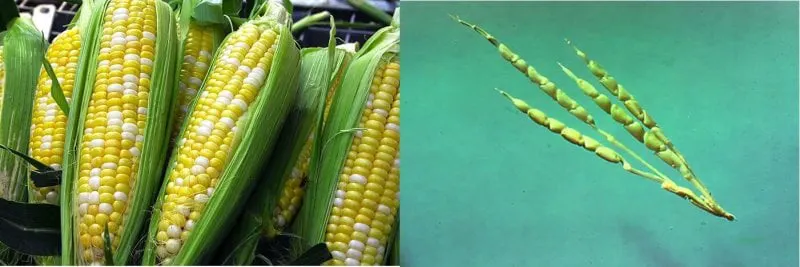
Before they occupied such a gargantuan portion of our diets, these organisms didn’t look much different than the weedy grasses gardeners and farmers pluck from their plots.
To make them edible, wild crop ancestors were subjected to a process known as domestication. Humans selected varieties of these species for favorable traits, such as larger and more numerous grains and loss of seed dispersal so that precious grains didn’t fall to the earth prior to harvesting.
The process of domestication undertaken by early agriculturalists to develop hearty crop varieties resulted in huge shifts in plant performance. Major genomic shifts underlie the significant transformations observed in the transition from weedy progenitors to domesticated crops.
Researchers are now able to study the genes that were selected for in the process of domestication by comparing the genomes of wild crop ancestors to those of modern varieties. Then, by comparing sets of genes selected during domestication from one crop to the next, researchers are able to generate an even more robust understanding of this process that can be leveraged for further crop improvement.
In a recent study published in Science, scientists compared genes important in domestication for rice and maize. Through this investigation they were able to identify a set of 490 genes that were common to improvement in both crops. One gene, known as KRN2 (kernel row number 2), was found to be important for grain yield in rice and maize. Using gene editing in rice and maize to generate loss-of-function mutations in KRN2 resulted in yield increases of 8 and 10 percent, respectively. Plants with edits exhibited no performance deficits despite having significantly greater yields.
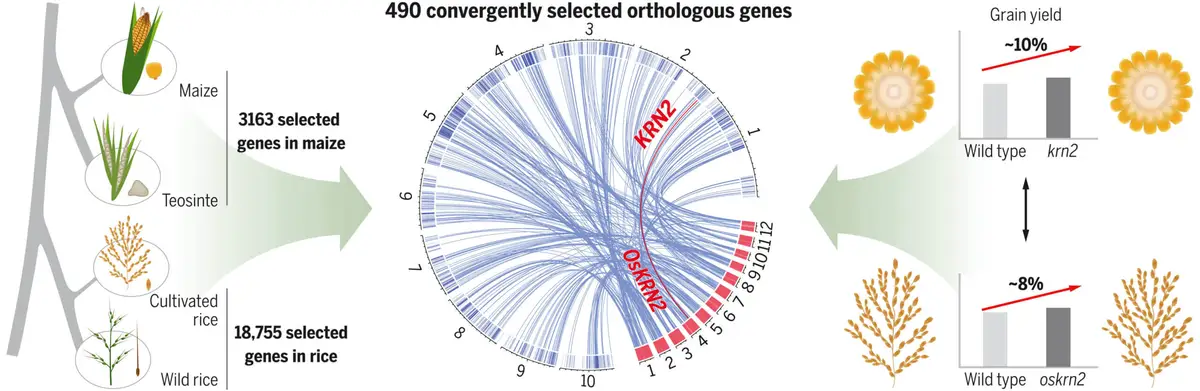
Yield improvements conferred by conventional breeding methods in major staple crops have stagnated within the last decades. The application of advanced breeding methods to generate significant yield benefits is thus an incredibly profound breakthrough. What’s more, the genes identified by studying wild crop ancestors in multiple species may serve as promising future targets for crop performance improvements using gene editing or other breeding methods.
Leveraging genomic understanding of how wild crop ancestors were domesticated into the crops that nourish the global population today has generated improved understanding of additional ways that crops may be further improved. From a list of genes generated using this approach, gene editing was applied to remove the function of a single gene in rice and maize, generating plants with greatly improved yields. Making use of this same approach for other genes in rice, maize and myriad staple crops could similarly produce crops with enhanced yields or performance features that are important to meet the increasingly severe demands placed on the global food system.
Nicholas Karavolias is a PhD candidate in the Staskawicz Lab at the University of California, Berkeley, a National Science Foundation Graduate Research Fellowships Program recipient and a FFAR Fellow.
A version of this article was posted at Cornell Alliance for Science and is used here with permission. You can check out Cornell Alliance for Science on Twitter @ScienceAlly

 | Videos | More... |

Video: Nuclear energy will destroy us? Global warming is an existential threat? Chemicals are massacring bees? Donate to the Green Industrial Complex!
 | Bees & Pollinators | More... |

GLP podcast: Science journalism is a mess. Here’s how to fix it

Mosquito massacre: Can we safely tackle malaria with a CRISPR gene drive?

Are we facing an ‘Insect Apocalypse’ caused by ‘intensive, industrial’ farming and agricultural chemicals? The media say yes; Science says ‘no’
 | Infographics | More... |

Infographic: Global regulatory and health research agencies on whether glyphosate causes cancer
 | GMO FAQs | More... |

Why is there controversy over GMO foods but not GMO drugs?

How are GMOs labeled around the world?

How does genetic engineering differ from conventional breeding?
 | GLP Profiles | More... |

Alex Jones: Right-wing conspiracy theorist stokes fear of GMOs, pesticides to sell ‘health supplements’

 Viewpoint — Fact checking MAHA mythmakers: How wellness influencers and RFK, Jr. undermine American science and health
 Viewpoint: Video — Big Solar is gobbling up productive agricultural land and hurting farmers yet providing little energy or sustainabilty gains
 Fighting deforestation with CO2: Biotechnology breakthrough creates sustainable palm oil alternative for cosmetics
 Trust issues: What happens when therapists use ChatGPT?
 California, Washington, Oregon forge immunization alliance to safeguard vaccine access against federal undermining
 30-year-old tomato line shows genetic resistance to devastating virus
 The free-range chicken dilemma: Better for birds, but with substantial costs
 ‘You have to treat the brain first’: Rethinking chronic pain with Sanjay Gupta