New EXPLORER Total-Body PET Scanner Enhances Detection of Brain Diseases
New EXPLORER Total-Body PET Scanner Enhances Detection of Brain Diseases
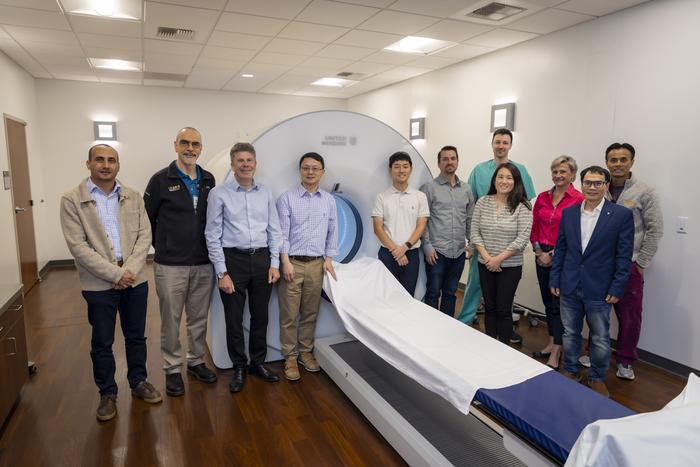
In a groundbreaking advancement that bridges the worlds of imaging technology and neurobiology, researchers at UC Davis Health have unveiled a revolutionary method for quantitatively assessing the blood-brain barrier (BBB) using their cutting-edge total body PET scanner, EXPLORER. This breakthrough paves the way for earlier and more precise evaluations of how systemic diseases, including cancer and neurodegenerative disorders, subtly alter the protective barrier that safeguards the brain. By harnessing the unparalleled sensitivity and temporal resolution of EXPLORER, combined with innovative modeling techniques, this new approach promises to radically transform our understanding and diagnosis of BBB dysfunction.
The investigation was spearheaded by radiology postdoctoral fellow Dr. Kevin Chung and colleagues under the supervision of Guobao Wang, a professor of Radiology and associate vice chair of Research, and Simon Cherry, distinguished research professor of Biomedical Engineering, both at UC Davis. Their work has culminated in a study published in the prestigious journal Nature Communications, where they detail a novel PET imaging methodology that surpasses the limitations of existing techniques, offering a more comprehensive and dynamic picture of BBB permeability at the molecular level.
The BBB is a highly selective, semipermeable border of endothelial cells that shields the central nervous system from potentially harmful agents while regulating the transport of essential molecules. Its integrity is fundamental to cerebral homeostasis. However, disruptions to BBB function have been increasingly implicated in a wide array of pathologies ranging from metabolic syndrome and cancer metastasis to the progression of Alzheimer’s and other neurodegenerative diseases. Despite its importance, monitoring BBB health non-invasively and quantitatively has remained a formidable challenge in clinical practice.
Traditional magnetic resonance imaging (MRI) methods have provided some insights into BBB permeability by detecting the leakage of contrast agents from blood vessels. However, MRI only reveals leakage at relatively advanced stages of barrier disruption, making it an insensitive modality for early detection. PET imaging, on the other hand, inherently offers molecular specificity and the capacity to track dynamic processes, but until now has required complex dual-tracer protocols to concurrently measure blood flow and molecular transport across the BBB. Such protocols involve flow tracers with very short radioactive half-lives, necessitating costly and often inaccessible on-site cyclotron facilities, thus limiting widespread clinical adoption.
The UC Davis team circumvented these constraints by leveraging the extraordinary temporal resolution and sensitivity of the EXPLORER PET scanner, an invention credited to Simon Cherry and Ramsey Badawi, vice chair for research in the Department of Radiology. EXPLORER’s ability to acquire rapid, whole-body imaging frames in as little as one second enabled the researchers to capture fleeting biological processes with unprecedented detail. This high frame rate was critical in disentangling complex radiotracer kinetics without relying on multiple tracers, simplifying the PET protocol and broadening its practical applicability.
By integrating advanced mathematical modeling with EXPLORER’s dynamic imaging data, the researchers successfully quantified subtle variations in transporter proteins that regulate molecular passage through the BBB. These transporters are pivotal in maintaining neural environments, and their altered function may serve as early biomarkers of BBB compromise before overt leakage occurs. Such early detection capabilities are crucial, as they may allow clinicians to monitor disease onset or progression far earlier than previously possible, opening new avenues for intervention and treatment.
Moreover, the team demonstrated that their technique could reliably measure physiological changes in BBB permeability associated with normal aging, as well as pathological alterations induced by systemic conditions like liver inflammation. This multidimensional capacity suggests that the imaging method is versatile and sensitive enough to detect a broad spectrum of BBB states, from health to disease, making it a powerful tool for both research and clinical settings.
One of the key strengths of this innovation lies in its compatibility with the vast array of over a thousand existing PET radiotracers. Because it does not depend on a specialized flow tracer, it offers extraordinary flexibility. Researchers and clinicians can select radiotracers targeting diverse molecular pathways involved in diseases, harnessing the new model to glean meaningful insights into BBB permeability within a variety of pathological contexts.
The impact of this technology extends beyond neurology. Since BBB dysfunction influences systemic diseases, for example, permitting cancer cells to invade the brain or altering brain function in metabolic disorders, this PET imaging advancement could have far-reaching implications. It might refine the way clinicians stage cancers with brain involvement, assess cognitive disorders with systemic etiologies, or track therapeutic responses across a spectrum of brain-related conditions.
The research team included multidisciplinary experts across nuclear medicine, oncology, gastroenterology, and population health, evidencing the collaborative and translational nature of the project. Supported by key funding from the National Institute of Biomedical Imaging and Bioengineering, the National Cancer Institute, and the National Institute of Diabetes and Digestive and Kidney Diseases, the work underscores the synergy between advanced technology development and clinical application in pursuit of medical breakthroughs.
In sum, the quantitative PET imaging and molecular modeling of BBB permeability introduced by UC Davis researchers represent a paradigm shift. By enabling highly sensitive, non-invasive, and dynamic assessments of the blood-brain barrier, this technology opens a new frontier in understanding brain health and disease. It equips the scientific and medical communities with a powerful instrument not only for early detection but also for ongoing monitoring of disorders that compromise this critical barrier, ultimately enhancing patient care and enabling the development of novel therapies.
Subject of Research: People
Article Title: Quantitative PET imaging and modeling of molecular blood-brain barrier permeability
News Publication Date: 30-Mar-2025
Web References:
- DOI link to the article
- UC Davis Health
- EXPLORER scanner
- PET technology overview
- Blood-brain barrier information
References:
Chung, K., Wang, G., Cherry, S., et al. (2025). Quantitative PET imaging and modeling of molecular blood-brain barrier permeability. Nature Communications. DOI: 10.1038/s41467-025-58356-7
Image Credits: UC Davis Health
Keywords: Blood brain barrier, Molecular imaging
Light Exercise May Slow Cognitive Decline in Individuals at Risk for Alzheimer’s, Study Finds
Next PostOldest Known Ant Fossil Unearthed in Brazil
Related Posts

Emerging Challenge in Prostate Screening: Insight from Primary Care Physicians
Uncovering the Key Interactions Behind Cell Migration in Brain Cancer
Developmental Biologist Maria Jasin Awarded 2025 Pearl Meister Greengard Prize
Harnessing Deep Learning to Revolutionize Precision Cancer Therapy
AI Matches Dermatologists in Accuracy of Skin Cancer Assessments