New Marine Flagellate Species Discovered
New Marine Flagellate Species Discovered
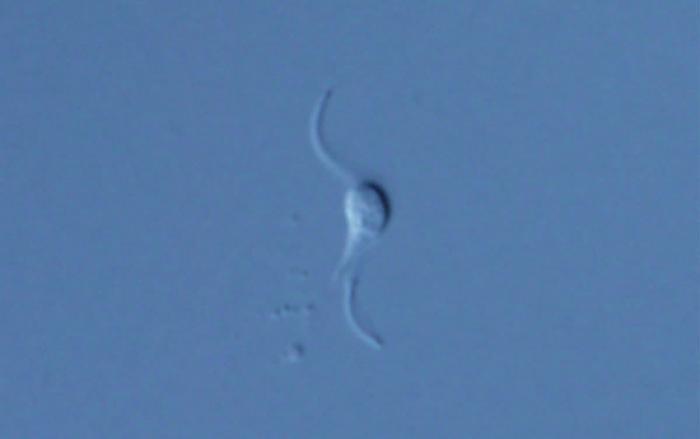
In a groundbreaking discovery that reshapes our understanding of protist biology and evolutionary history, researchers from the University of Tsukuba have identified a novel flagellated protist within the enigmatic group Endomyxa. This discovery challenges long-held assumptions that members of this group either lack flagella entirely or possess them only transiently during certain life stages. The organism, designated as Viscidocauda repens, exhibits a continuously present flagellum, a unique trait that compels biologists to reconsider the evolutionary trajectory and diversity of Endomyxa.
Endomyxa, a clade within the Rhizaria supergroup, has traditionally been characterized by a variety of lifestyles ranging from intracellular parasitism to free-living amoeboid forms. Prior to this study, no free-living endomyxan was known to maintain a persistent flagellum. Flagella are whip-like appendages that play critical roles in cell motility and environmental sensing, yet the absence or ephemeral nature of flagella in Endomyxa has puzzled evolutionary biologists. The discovery of V. repens suggests that the last common ancestor of Endomyxa may have been flagellated, underscoring a more intricate evolutionary history than previously appreciated.
The journey toward this revelation began with the collection of seawater samples, which harbored a microbial community ripe for exploration. Using meticulous culturing techniques, the research team isolated and maintained a viable culture of the protist. This feat itself presented a technical challenge, given the minute size and specific environmental conditions necessary for sustaining such novel microorganisms. The successful cultivation enabled exhaustive morphological, ultrastructural, and molecular examinations under state-of-the-art microscopy and genetic sequencing platforms.
Microscopic analysis of V. repens unveiled a cellular morphology unlike any other known flagellates within this group. The organism displays distinctive cytoplasmic structures with a conspicuously visible flagellum, which remains extended throughout its life cycle. Advanced light microscopy and electron microscopy techniques revealed that V. repens possesses complex internal cellular architecture, including a specialized flagellar insertion apparatus and unique organelle arrangements. These traits suggest adaptations that could facilitate distinct modes of motility and environmental interaction.
Molecular phylogenetics solidified the classification of V. repens within Endomyxa. DNA sequence comparisons targeting conserved genes such as SSU rRNA, among others, placed this new genus and species squarely within this clade. The genetic data illuminated evolutionary relationships that hinted at the presence of flagella in ancestral endomyxan lineages. This overturns previously accepted phylogenetic models, which regarded flagella as either lost or restricted to dormant or reproductive stages in Endomyxa.
The confirmation of flagellar presence in V. repens has profound implications for understanding cellular evolution among protists. Flagella are fundamental organelles implicated in cell motility, feeding, and sensory functions. Their persistence in this newly described protist signals a possible retention of ancestral traits that may have been secondarily lost or reduced in related taxa. This insight invites a re-examination of protist evolutionary pathways, considering both genetic and functional perspectives of organelle utilization.
Biologically, the presence of a persistent flagellum suggests novel ecological strategies employed by V. repens. Unlike parasites or transiently flagellated stages, this organism likely utilizes its flagellum for continuous locomotion in marine environments, possibly enhancing its ability to navigate microscale habitats, seek nutrients, or evade predators. Future studies examining its behavior under varying environmental stimuli could elucidate the ecological role of this species and its impact on microbial community dynamics.
From a broader evolutionary biology standpoint, V. repens challenges the dogma that Endomyxa are primarily amoeboid organisms devoid of locomotory flagella. The retention of flagellar machinery suggests a more plastic evolutionary adaptation than previously acknowledged. It also raises questions about the selective pressures and genetic mechanisms that led to flagellar loss in other endomyxan lineages, a fertile area for comparative genomics and cell biology research.
This discovery also emphasizes the importance of exploring understudied microbial niches, particularly in marine ecosystems where microbial diversity remains vastly uncharacterized. The identification of V. repens was contingent on advanced culturing and microscopic techniques, highlighting the synergy between methodological innovation and classical microbiological inquiry in unveiling cryptic biodiversity.
Furthermore, the detailed description and naming of this organism as Viscidocauda repens establish a taxonomic framework for future investigations. As the first free-living, flagellated member of Endomyxa documented, it serves as a reference point for revisiting evolutionary relationships within Rhizaria and refining the phylogenetic tree that maps protist diversity.
As researchers continue to probe deeper into protist biology, this finding heralds a new era of discovery regarding the functions and evolution of cellular organelles across diverse lineages. The persistence of a flagellum in V. repens enriches our understanding of cellular complexity and opens the door to deciphering evolutionary reversals and convergences in organelle morphology and function.
In sum, the identification of Viscidocauda repens signifies a remarkable paradigm shift in protistology, compelling a rewrite of endomyxan evolutionary narratives. It underscores the dynamic nature of microbial evolution and the continual need to reconcile morphological and molecular data to appreciate the full spectrum of eukaryotic life’s history and innovation.
Subject of Research: Evolutionary biology and cell morphology of protists; discovery of a flagellated free-living endomyxan protist.
Article Title: A novel free-living endomyxan flagellate Viscidocauda repens gen. nov., sp. nov.
News Publication Date: 14-Apr-2025
Web References:
Protist Journal DOI link
Institute of Life and Environmental Sciences, University of Tsukuba
Assistant Professor Takashi Shiratori’s profile
References: DOI 10.1016/j.protis.2025.126101
Image Credits: University of Tsukuba
Keywords: Protists, molecular phylogenetics, taxonomies, flagella, Endomyxa, evolutionary biology, microbial diversity, Rhizaria, cellular morphology
New Peptide Drug Shows Promise in Fighting Deadly Brain Cancer, Researchers Reveal
Next PostRecycling EV Batteries: Essential for Securing Future Lithium Resources
Related Posts

Powerful Dechlorination of Pollutants by Cobalamin and Iron
New Study Connects Atmospheric and Oceanic Processes in Weathering and CO2 Removal
Reusable Photocatalytic Film Boosts Low-Light Water Disinfection
Kelp Forests: Vital Links to Local Beach Ecosystems
How Charge Uniformity Enhances Ion Selectivity in Membranes