Poll Shows Declining Trust in Public Health Guidance Amid Federal Leadership Changes
Poll Shows Declining Trust in Public Health Guidance Amid Federal Leadership Changes
Embargoed for Release: Tuesday, April 29, 2025, 6:00 AM ET
Trust in Public Health Agencies Faces New Challenges Amid Political Shifts
As the United States marks 100 days into its new federal administration, an extensive national poll conducted by the Harvard T.H. Chan School of Public Health and the de Beaumont Foundation reveals deepening divisions in public trust toward federal public health agencies. According to the survey, nearly half of U.S. adults express concerns that changes in agency leadership will diminish their trust in public health recommendations. These findings underscore a fault line dividing the American public along partisan lines, reflecting broader skepticism about the role and functioning of institutions like the Centers for Disease Control and Prevention (CDC) in the rapidly evolving political landscape.
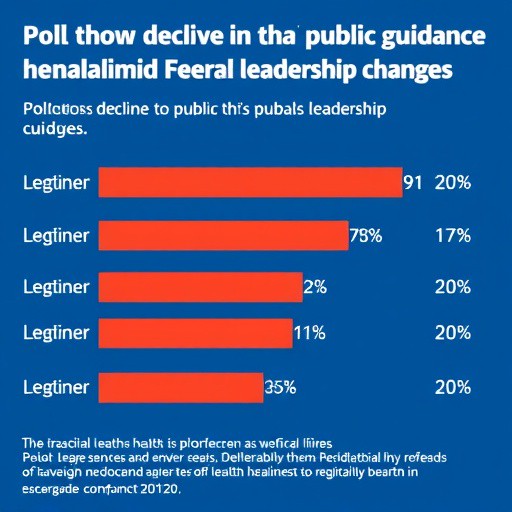
The study surveyed a nationally representative sample of 3,343 U.S. adults between March 10 and 31, 2025, providing a comprehensive snapshot of current public sentiment. Despite a historical perception of the CDC as a cornerstone of health guidance, trust appears increasingly fragile amid changing leadership. Approximately 44% of respondents say they expected to lose some level of trust in recommendations from federal health agencies under the new administration, while only 28% anticipate gaining trust. This trend indicates a waning confidence that could undermine public health efforts nationwide.
In examining the partisan dynamics fueling these trust gaps, the survey reveals a stark contrast: 76% of Democrats anticipate losing trust in public health agencies with the new leadership, including a substantial 56% who expect a strong decline in trust. Conversely, 57% of Republicans express optimism, predicting increased trust, although fewer (23%) expect a significant trust gain. This polarization illustrates how public confidence in scientific institutions and health guidance is increasingly filtered through political identity, complicating unified health communication efforts.
Further complicating the outlook is the public’s divided expectation regarding the functional capacity of the CDC in coming years. The poll finds a nearly even split—with 48% optimistic about improved functionality and 52% pessimistic. Notable partisan differences emerge here as well: 80% of Republicans believe the agency will perform better, whereas 83% of Democrats expect worsening performance. This divergence reflects broader perceptions of institutional efficacy and may influence cooperation with forthcoming public health initiatives.
Among those predicting diminished CDC performance, substantial concerns crystallize around the potential politicization of health recommendations. Seventy-six percent of this group worry that the agency may issue guidance influenced by political agendas, while 75% fear significant program reductions. Additional apprehensions focus on the risk of downplaying critical health issues such as infectious disease outbreaks (72%) and limiting public access to vital information on vaccines and other preventive measures (70%). These fears highlight the intricate relationship between governance, science communication, and public health transparency.
Interestingly, even respondents who anticipate improved CDC functioning exhibit measured confidence in the agency’s prospective achievements. Only a minority express strong faith that the agency will fulfill promises related to reducing financial waste (33%) or basing recommendations on rigorous research previously overlooked (28%). Trust in the CDC’s capacity to diminish political and corporate interference remains notably low, with fewer than one in five very confident in such progress. This cautious optimism reflects a broader skepticism about structural reforms in public health leadership.
The implications of these findings extend beyond public perceptions into practical challenges for public health policymakers and communicators. Dr. Gillian SteelFisher, director of the Harvard Opinion Research Program, notes emerging “fault lines in trust” that threaten to impede the effective transmission of health information. She emphasizes that rebuilding public confidence will require demonstrable commitment to sustaining and enhancing public health infrastructure amid political transitions. This task is urgent given the ongoing threats posed by infectious diseases and chronic health conditions alike.
Amid the partisan divides, the poll uncovers rare bipartisan consensus around several pressing health priorities. Both Democrats and Republicans overwhelmingly support efforts to prevent chronic diseases, with approval ratings of 91% and 86%, respectively. Protecting the nation from emerging viral pandemics also garners strong support, especially among Democrats (92%) and Republicans (75%), reflecting shared concerns shaped by recent global health crises. These aligned priorities offer a potential pathway for collaborative policy action despite broader ideological polarization.
Other health issues resonating across party lines include reducing maternal and infant mortality, safeguarding drinking water quality, addressing mental illness, and tackling opioid and substance addiction. Although some variation exists in levels of emphasis—such as Republicans placing comparatively higher priority on nutrition and Republicans and Democrats differing slightly on concerns about common health risks—the overall pattern suggests that public health can still serve as a domain of common ground for bipartisan cooperation in the coming years.
These findings arrive at a critical juncture, as federal, state, and local public health agencies confront evolving challenges that demand both scientific rigor and public trust. According to Brian C. Castrucci, president and CEO of the de Beaumont Foundation, the respondents’ collective voice is a “call to action” to bolster investments in proven public health programs, reform areas of weakness, and foster collaboration. The urgent task ahead is not simply to manage health crises but to rebuild an inclusive health system that commands confidence across the political spectrum.
From a methodological perspective, this research employs rigorous survey techniques, including probability-based sample selection and weighting to reflect the demographics and political affiliations of the adult U.S. population. Conducted in English and Spanish via mixed online and telephone modes, the study addressed potential nonresponse bias through advanced statistical adjustments. With margins of error under ±3.1 percentage points for major political subgroups, the findings provide robust insight into the public’s health perceptions amidst a period of profound institutional change.
As the new administration navigates its path forward, acknowledging the complex interplay of trust, partisan identity, and policy priorities will be essential in shaping effective public health strategies. The data signal that without concerted efforts to transcend political divides and demonstrate transparency, public health agencies risk losing the very trust that underpins their efficacy. Conversely, consensus on critical health challenges offers a hopeful foundation for renewed collaboration in protecting the health of all Americans.
Subject of Research: People
Article Title: A View from 100 Days: Public Expectations about the Changing Public Health Landscape
News Publication Date: 29-Apr-2025
Web References:
Harvard T.H. Chan School of Public Health
Keywords: Public health, Public opinion, Government
Breaking Through the Quantum Sensing Barrier
Next PostADHD, Emotion Regulation, and Sleep Quality Linked
Related Posts

Reevaluating Fertility Changes Through Mortality Insights
Linking Multimodal Risks to Mental Health Outcomes
Link Between Parental Diseases of Despair and Increased Risk of Suicide in Offspring
Mobility Assistance Dogs Enhance Quality of Life in Children with Impaired Walking, Say Parents
Study Finds AI Tools Inadequate for Predicting Suicide Risk