Revolutionizing Power Electronics: Diamond Quantum Imaging Targets Energy Loss
Revolutionizing Power Electronics: Diamond Quantum Imaging Targets Energy Loss
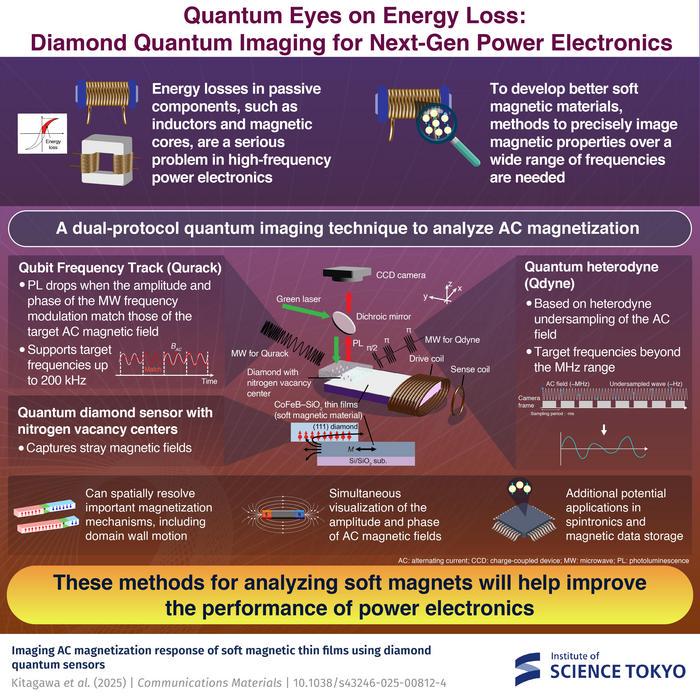
In the quest for a sustainable energy future, one of the most pressing challenges is enhancing the efficiency of power electronics. This has become increasingly crucial as global demand for energy intensifies. Emerging technologies, particularly wide-bandgap semiconductors such as Gallium Nitride (GaN) and Silicon Carbide (SiC), showcase remarkable advantages in high-frequency performance essential for modern electronic devices. Nonetheless, energy losses occurring in passive components at elevated frequencies present significant hurdles, impeding the pursuit of greater efficiency and miniaturization. This situation emphasizes the necessity for advanced soft magnetic materials engineered to minimize energy dissipation.
A pivotal study recently published in Communications Materials, conducted by a research team led by Professor Mutsuko Hatano at the Institute of Science Tokyo in Japan, introduces a novel method for analyzing energy losses in soft magnetic materials. Utilizing diamond quantum sensors paired with nitrogen-vacancy (NV) centers, the team has developed innovative imaging techniques capable of simultaneously capturing the amplitude and phase of alternating current (AC) stray fields. This dual imaging approach is vital for a comprehensive understanding of hysteresis losses, a phenomenon critically linked to energy waste in electronic systems.
The collaborative effort, which involves esteemed institutions such as Harvard University and Hitachi, Ltd., aims to address the complexities associated with imaging AC magnetic fields. The researchers implemented two distinct protocols, namely Qubit Frequency Tracking (Qurack) for kilohertz frequencies and quantum heterodyne (Qdyne) imaging for megahertz frequencies. This groundbreaking research paves the way for a versatile wide-range AC magnetic field imaging method that can significantly enhance our knowledge of energy loss mechanisms in high-frequency electronic applications.
In a groundbreaking proof-of-principle experiment, the team demonstrated their imaging prowess by applying an AC current to a 50-turn coil and sweeping the frequency from 100 Hz to 200 kHz for Qurack, and from 237 kHz to 2.34 MHz for Qdyne. Such rigorous experimentation resulted in the successful imaging of the amplitude and phase of the uniform AC magnetic field, achieved through the high spatial resolution provided by NV centers, which ranged from 2 to 5 micrometers. The validation of these measurement protocols is a significant leap forward in the capacity to analyze soft magnetic materials.
One of the key materials examined in this study was the CoFeB–SiO₂ thin films, which have been specifically tailored for use in high-frequency inductors. The research revealed that these films exhibit a near-zero phase delay at frequencies up to 2.3 MHz, indicative of minimal energy losses along the hard axis. Moreover, the findings elucidated the relationship between energy loss and the material’s magnetic anisotropy. The results show that when magnetization is manipulated along the easy axis, there is a notable increase in phase delay with frequency, highlighting a concerning uptick in energy dissipation.
This pioneering innovation not only contributes to our understanding of magnetization mechanics but also marks a significant advancement in the field of quantum sensing. The ability to effectively resolve domain wall motion—crucial to understanding energy loss—stands out as a critical step toward practical improvements and optimizations in electronic systems. Researchers have underscored that being able to analyze soft magnetic materials under such high-frequency conditions is essential for propelling forward efficient electronic designs that align with modern sustainability goals.
Looking ahead, the team, spearheaded by Professor Hatano, expresses optimism about further enhancing the techniques demonstrated in this study. They anticipate exploring engineering improvements that could enrich the systems. For instance, by incorporating advanced signal generators to amplify Qurack’s performance and optimizing existing microwave control speeds and spin coherence times, the Qdyne technique may significantly broaden its frequency detection capabilities.
Notably, the simultaneous imaging of AC magnetic field amplitude and phase across an extensive frequency spectrum brings promising potential applications. This multifaceted imaging capacity can translate into advancements not only in power electronics but also in electromagnets, non-volatile memory technologies, and spintronics. As Professor Hatano emphasizes, these successes greatly contribute to the acceleration of quantum technologies, especially in sectors focused on sustainable development and overall human well-being. The intersection of quantum mechanics and material science holds the promise for revolutionizing sectors dependent on efficient energy conversion.
The methodology explored in this research presents a vibrant future for the integration of quantum sensors into practical applications. As scientists continue to delve deeper into the complexities of material properties at finite high frequencies, the groundwork has been laid for innovative technologies that can significantly reduce energy losses in power electronic systems. Advances in quantum sensing technologies represent not only a leap forward in fundamental research but also unlocked potential for widespread commercialization and application in sectors striving for efficiency.
Thus, the implications of this research stretch far beyond laboratory confines. As researchers build on the findings presented by Hatano and his team, the integration of diamond quantum sensors with evolving strategies will catalyze the development of increasingly efficient electronic systems. Such improvements will undoubtedly resonate across multiple industries, with significant ripplings in reducing environmental impacts and paving the way for achieving ambitious sustainability targets in energy consumption and conservation.
In conclusion, the ongoing research at the Institute of Science Tokyo illuminates the untapped potential of quantum technologies in addressing pressing global energy challenges. As we unearth the intricacies of magnetic field behaviors and their correlations with energy loss through cutting-edge imaging techniques, the horizon glows brightly with possibilities for creating a more energy-efficient, sustainable future.
Subject of Research: Energy Loss Analysis in Soft Magnetic Materials
Article Title: Imaging AC Magnetization Response of Soft Magnetic Thin Films Using Diamond Quantum Sensors
News Publication Date: 23-May-2025
Web References: https://doi.org/10.1038/s43246-025-00812-4
References: Not Applicable
Image Credits: Science Tokyo
Keywords
Quantum magnetism, Imaging, Sensors, Magnetic fields, Magnetic anisotropy, Semiconductors
Retracted Study on E-Learning’s Impact on Student Well-being
Next PostGIS-Based Downscaling of Soil Erodibility by Terrain
Related Posts

Vanderbilt and Fritz Haber Institute Unveil Breakthrough in Nanoscale Light Confinement, Paving the Way for Terahertz Optics and Optoelectronic Innovation
When Wireless Data Sources Deplete: Implications for Connectivity
NJIT Student-Faculty Team Recognized with Best Presentation Award for Innovative Ant Swarm Simulation
Revealing the Ingenious Architecture of Honeybees: New Study Uncovers How Bees Build Hives in Challenging Locations
UC3M Conducts Research to Safeguard Astronauts’ Cardiovascular and Ocular Health