Rising Burden of Skin Cancer in Older Adults: Trends from 1990 to 2021 and Projections Through 2050
Rising Burden of Skin Cancer in Older Adults: Trends from 1990 to 2021 and Projections Through 2050
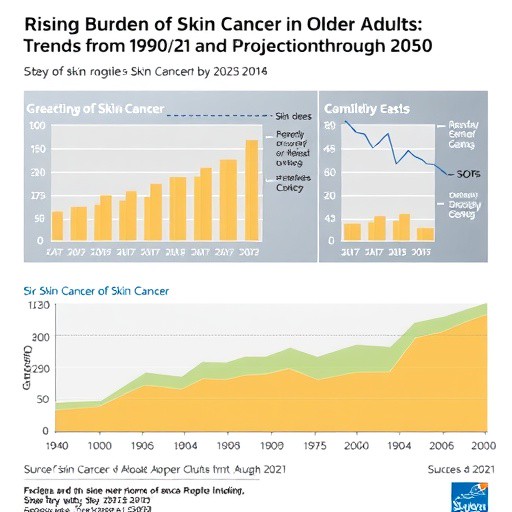
In recent years, the escalating incidence of skin cancer among older populations has emerged as a significant public health concern worldwide. A comprehensive new study highlights that this trend is particularly pronounced among male individuals and those residing in countries with a high sociodemographic index. The data suggest a troubling rise in the burden of keratinocyte cancers—types of skin cancer that arise from keratin-producing cells in the epidermis—underscoring an urgent need to refine prevention and management strategies tailored to high-risk groups.
Keratinocyte cancers, primarily basal cell carcinoma and squamous cell carcinoma, represent the most common forms of skin malignancies globally. Despite their high prevalence, official data collection on these cancers suffers from notable gaps. Current registries often lack comprehensive race and ethnicity information, complicating efforts to understand disparities in disease incidence and outcomes. This inadequacy in data collection arguably hampers the development of targeted interventions that could curb the disease burden, particularly in vulnerable demographics.
The study’s analysis points decisively toward a demographic skewing, where older males in developed, high sociodemographic index countries face disproportionate risks. Epidemiologically, this observation aligns with known risk factors, including cumulative ultraviolet (UV) radiation exposure over a lifetime, occupational hazards, and possibly behavioral disparities such as lower adherence to sun protection measures. The physiological aging process itself also contributes to a diminished capacity for DNA repair mechanisms, which exacerbates vulnerability to UV-induced carcinogenesis.
Intriguingly, although the study acknowledges significant progress in understanding skin cancer’s etiology, it also stresses key knowledge gaps that impede comprehensive risk assessment. For instance, the relative incompleteness of keratinocyte cancer data limits precise incidence tracking over time and across diverse populations. This is compounded by underreporting in regions lacking advanced dermatological healthcare infrastructure, further skewing epidemiological data and obscuring true global disease patterns.
The absence of granular racial and ethnic data further complicates the epidemiological picture. Skin cancer risk varies dramatically depending on pigmentation levels, genetic factors, and social determinants of health. Populations with darker skin tend to have lower incidence rates but may experience worse outcomes due to delayed diagnosis and treatment. Without detailed demographic capture, these nuances remain underexplored, delaying the formulation of equitable healthcare policies.
Given these multifaceted challenges, the study strongly advocates for intensified research efforts and more robust data collection systems. Implementation of standardized reporting protocols across countries and health systems could improve the quality of cancer registries. Enhanced utilization of electronic health records and integration of genomic and environmental exposure data could further refine risk stratification models, enabling early detection in at-risk populations.
Prevention strategies must evolve in tandem with these data improvements. Public health campaigns targeting older adult males, especially in high sociodemographic index countries, could amplify awareness around sun safety and the necessity of regular skin examinations. Innovations in wearable UV sensors and mobile health applications offer promising avenues for real-time monitoring of UV exposure, potentially mitigating cumulative damage.
Advances in diagnostic technology, including non-invasive imaging techniques like reflectance confocal microscopy and optical coherence tomography, hold potential to revolutionize early skin cancer detection. Coupled with machine learning algorithms capable of interpreting complex imaging data, these tools may facilitate earlier interventions, ultimately reducing morbidity and healthcare costs associated with advanced cancers.
Therapeutics, too, are entering a new era. Recent developments in immunotherapy and targeted molecular treatments have shown efficacy in advanced keratinocyte cancers. Nevertheless, accessibility and cost remain substantial obstacles, particularly in lower-resource settings. Therefore, global efforts to democratize these innovations—in parallel with preventative strategies—are critical to addressing the burgeoning burden.
The study’s findings also underscore the importance of interdisciplinary collaboration in tackling skin cancer. Dermatologists, oncologists, epidemiologists, and public health officials must coordinate to create comprehensive frameworks addressing the disease’s multifactorial nature. Socioeconomic determinants, environmental policies regarding UV regulation, and personalized medicine approaches should be integrated to optimize outcomes.
Ultimately, this research serves as a clarion call to the medical and scientific communities. With aging populations worldwide, the sheer scale of skin cancer incidence threatens to overwhelm healthcare systems unless substantive preventive and therapeutic measures are adopted promptly. Policymakers, clinicians, and researchers must act decisively to prioritize high-risk groups and refine tools for early diagnosis, data collection, and patient education.
In summation, the growing global burden of skin cancer among older adults, and particularly older males in affluent countries, represents a formidable challenge. Addressing this issue demands enhanced data infrastructure, innovative technological applications, equitable healthcare delivery, and targeted public health interventions. Through these concerted efforts, it is possible to attenuate the rise of keratinocyte cancers and improve quality of life for aging populations worldwide.
Subject of Research: The increasing burden and epidemiology of skin cancer among older adults, focusing on keratinocyte cancers in high sociodemographic index countries.
Article Title: Not provided.
News Publication Date: Not provided.
Web References: Not provided.
References: (doi:10.1001/jamadermatol.2025.1276)
Image Credits: Not provided.
Keywords: Skin cancer, Older adults, Keratinocyte cancer, Epidemiology, Public health, UV exposure, Prevention strategies, High sociodemographic index countries.
SwRI Scientist Uncovers Impact of Solar Events on Helium Pickup Ion Speeds
Next PostExploring Hydrogen Molecules in Atomic-Scale Cavities Through Picometric Spectroscopy
Related Posts

Moffitt Researchers Create Machine Learning Model to Forecast Urgent Care Visits in Lung Cancer Patients
New Review Advocates Age-Specific Immunotherapy Approaches for Childhood Brain Tumors
Microarray Profiling Reveals Differential Long Non-Coding RNA Expression in Peripheral Blood Mononuclear Cells of Luminal A Breast Cancer Patients
Antisense LNA GapmeR Targets hsa-piR-33195, Halts Leukemia
Bar-Ilan University and Sheba Medical Center Launch $120M Joint Institute to Drive Biotech Innovation