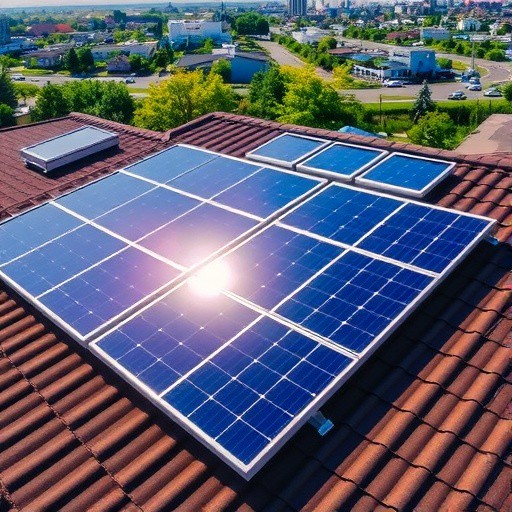
Rooftop Solar Power Could Curb Global Warming
Rooftop Solar Power Could Curb Global Warming
ADVERTISEMENT
The text you provided describes a comprehensive methodology and evaluation for estimating global rooftop area using a two-stage process:
Summary of the Two-Stage Process for Global Rooftop Area Estimation
Stage 1: Top-down approach using deep learning
- Goal: Quantify rooftop area in selected representative regions.
- Method:
- Used SegFormer, a cutting-edge Vision Transformer-based deep learning model.
- Pretrained on publicly available building identification datasets (~2,500 km² across diverse regions, spatial resolutions 0.1 m to 3 m).
- Fine-tuned using high-resolution Google Earth imagery (~1.2 m resolution), which is cloud-free and harmonized from multiple satellite/airborne platforms.
- Sample selection:
- 1,724 cities were chosen based on geographical and environmental representativeness using a K-means clustering of natural and human environmental features and a spatial sampling scheme optimized by simulated annealing.
- Output: Quantified rooftop area per city/region.
Stage 2: Bottom-up approach using random forest ensembles
- Goal: Extrapolate rooftop area to global scale.
- Method:
- Collected multi-source geospatial variables at 1 km² grid scale: built-up proportion, night-time light intensity, road length, population, tree cover, terrain elevation & slope, geographic coordinates, etc.
- Aggregated rooftop areas from top-down stage to these grid cells.
- Developed regression and classification random forest ensembles to model nonlinear relationships between geospatial variables and rooftop area.
- Excluded grids with no high-resolution imagery; total 8.5 million grid samples used.
- Postprocessing: Used a water map to allocate zero rooftop area to grids fully covered by water.
Model Evaluation
Evaluating the deep learning model (top-down):
- Created a global representative test set: 386 one-km² plots across countries; manually labelled rooftop areas.
- 2,951 image patches processed for validation.
- Performance:
- True positive rate (rooftop correctly identified): 76%
- False positive rate (non-rooftop misclassified as rooftop): 2.7%
- Compared favorably with state-of-the-art building footprint datasets (MBF: 61.6% TPR, 4% FPR; GBF: 66.5% TPR, 3.8% FPR).
- Strong correlation between predicted and actual rooftop area:
- r² = 0.93
- Slope = 1.04
- Performance varied by macroregion:
- Economically developed regions: r² > 0.95
- Less developed regions: r² ~ 0.9
Evaluating the random forest model (bottom-up):
- Selected 16,000 independent grid samples (800 per macroregion).
- Quantified rooftop area using high-resolution imagery and compared to random forest predictions.
- Performance:
- Overall r² = 0.89, slope = 0.87 (slight underestimation)
- Lower accuracy for some regions:
- Pacific Islands: r² = 0.61, bias error = 55%
- Western Asia: r² = 0.67, bias error = 24%
- Residual analysis showed greater errors in grids with larger rooftop areas.
- Residuals roughly normally distributed, mostly within ±5,000 m².
Important Notes
- The bias error formula normalizes the absolute error by the observed rooftop area sum:
[
\text{bias} = \frac{\left|\sum{N} \left(Y{\text{obs}} – Y{\text{pred}}\right)\right|}{\left|\sum{N} Y_{\text{obs}}\right|}
]
where (Y{\text{obs}}) is observed rooftop area and (Y{\text{pred}}) predicted rooftop area.
Summary conclusion
- The integration of a deep learning model for building rooftop detection with random forest regression using multiple geospatial predictors enables accurate estimation of rooftop areas globally.
- While the model performs best in well-represented, economically developed regions, some limitations exist for under-sampled regions such as small island states and parts of Asia.
- Overall, the two-stage framework provides a scalable, data-driven method for global rooftop area estimation which can support various applications including urban planning, renewable energy potential assessment, and sustainability efforts.
If you want, I can help with a more detailed explanation of any stage, discussion about the methodology, or assist in interpreting the results further!
Previous Post
New Tool Validates STEM Skills in Secondary Students
Next PostDeep Reinforcement Learning Enhances Optical Data Processing
Related Posts

Climate
Ignoring Land–Atmosphere Feedbacks Overstates Evapotranspiration Rise
Climate
Warming, Wildfires Threaten Showy Dragonflies’ Survival
Climate
Waterfowl Accelerate Migration Amid Arctic Warming
Climate
Rising Heat Drives Sugar Intake in Disadvantaged US Groups
Climate
Ocean Carbon Sink Drops Amid 2023 Heat Record
Climate