Study of Dinosaur Eggshells Confirms Biological Formation of Secondary Eggshell Structures
Study of Dinosaur Eggshells Confirms Biological Formation of Secondary Eggshell Structures
A recent breakthrough in paleontological biomineralization research has unveiled critical insights into the nature and evolutionary significance of secondary eggshell units (SEUs) found in dinosaur eggshells. For decades, the origins and formation mechanisms of these calcitic structures have remained enigmatic, leaving scientists divided over whether they are products of biological processes or mere abiogenic artifacts. This groundbreaking study, spearheaded by Dr. Shukang Zhang and postdoctoral researcher Dr. Seung Choi at the Institute of Vertebrate Paleontology and Paleoanthropology (IVPP), Chinese Academy of Sciences, leveraged state-of-the-art microscopy and crystallographic methods to provide compelling evidence affirming the biogenic origin of SEUs in non-avian dinosaur eggshells.
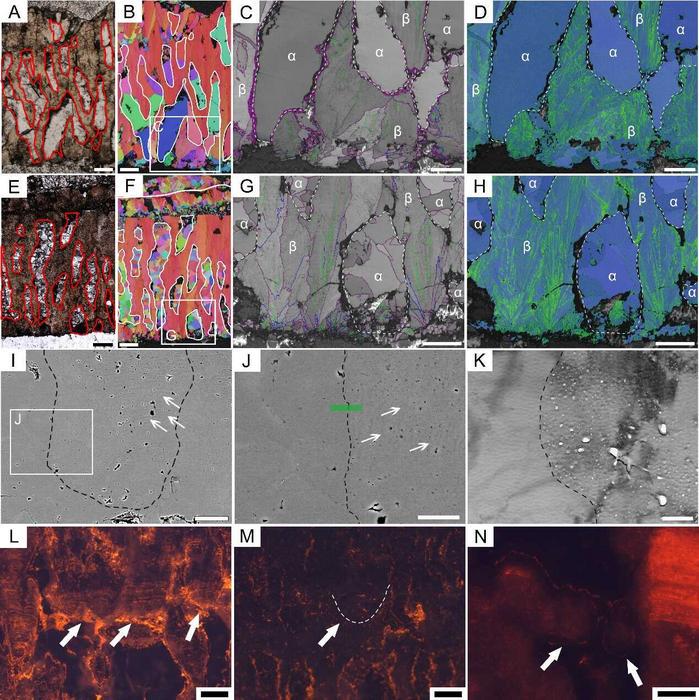
Eggshells, composed primarily of calcite, form complex microstructures aptly called eggshell units, which develop during the mineralization process. Primary eggshell units (PEUs) initiate growth from the shell membrane, while SEUs arise within the calcitic layer itself. In extant reptiles and birds, SEUs are generally rare in avian eggshells but have been a common feature in dinosaur eggshells. Despite their prevalence, scientific ambiguity persisted due to the paucity of deep structural and crystallographic investigations. The IVPP team approached this challenge by integrating electron backscatter diffraction (EBSD), polarized light microscopy (PLM), scanning electron microscopy (SEM), and transmission electron microscopy (TEM) to meticulously compare SEUs and PEUs across a range of species, including modern birds, turtles, crocodilians, and fossilized dinosaur specimens.
One of the salient findings of the comprehensive analyses was the remarkable crystallographic congruence between SEUs and PEUs within dinosaur eggshells. The EBSD and PLM studies revealed that the c-axis orientations of calcite crystals in both units showed consistent alignment patterns, indicating a regulated biomineralization process rather than random abiotic crystallization. In marked contrast, abiogenic calcite exhibited erratic crystallographic orientations and lacked characteristic microstructural features. SEM and TEM imaging further corroborated these differences by highlighting organic-matrix-related growth lines and porous structures uniquely present in biogenic calcite grains of SEUs.
The study paid particular attention to the presence of grooves and vesicles embedded within the SEUs of dinosaur eggshells. These micro-features resemble the degradation remnants of organic matrix fibers, suggesting that the organic framework played a pivotal role in guiding mineral deposition during eggshell formation. Comparable microscopic observations in modern bird eggshells reinforced the hypothesis that SEUs are biologically orchestrated structures rather than post-mortem mineral deposits or taphonomic anomalies. These insights collectively underscore the biogenic nature of the SEUs in non-avian dinosaur eggshells, providing a critical piece of evidence to unravel the complex biomineralization processes of extinct archosaurs.
Intriguingly, the team observed that in certain dinosaur eggshells characterized by well-developed pore canals, SEUs were found to overlap or even occupy positions within these pores, growing alongside PEUs without evident interruption. This phenomenon challenges the prevailing "competition hypothesis" derived from avian models, which posits that adjacent calcite crystals compete for spatial dominance, influencing crystallographic orientation. Instead, the findings suggest that the orientation of the c-axis in eggshell units is predominantly governed by organic matrix fibers, indicating a more nuanced and potentially universal biomineralization regulation mechanism across diverse species.
From an evolutionary standpoint, the distribution of SEUs across various dinosaur clades offers fascinating insights into the adaptive dynamics of eggshell formation. SEUs were ubiquitously present in sauropods, hadrosaurs, and basal tetanurans but were notably scarce among maniraptoran theropods, including modern birds. This disparity hints at a potential evolutionary transition in eggshell microstructure and mineralization strategies during the origin and evolution of avian eggs. Such a transformation might reflect changes in reproductive ecology, eggshell function, or embryonic development, opening new avenues for paleobiological and evolutionary interpretations.
Extending beyond dinosaurs, SEUs also appear in the eggshells of extant reptiles, such as turtles and crocodilians, further complicating their evolutionary trajectory. The presence of similar calcitic structures across these diverse archosaur lineages invites speculation about the possibility of deep homology at the molecular level of biomineralization. While the independent evolution of SEUs in distinct lineages remains plausible, shared developmental pathways and genetic regulation mechanisms could underpin these morphologically convergent features. Future molecular and genetic analyses may be essential to disentangle these competing evolutionary hypotheses.
The study also critically evaluated the efficacy of cathodoluminescence (CL) imaging for differentiating biogenic from abiogenic calcite. Contrary to previous assumptions, SEUs exhibited dark or orange fluorescence signals under CL, indicating that this method alone is insufficient for reliable identification of biogenic calcite in complex eggshell structures. This finding emphasizes the necessity of employing multifaceted analytical techniques, combining crystallographic, microscopic, and chemical assays to comprehensively characterize fossil biominerals.
Beyond resolving fundamental questions about eggshell unit origins, this research has broader implications for understanding vertebrate reproductive evolution and the functional morphology of eggshells. The intricate regulation of crystal orientation and the role of organic matrices in mineralization processes illuminate how living organisms modulate biomineral architecture to meet ecological and developmental demands. These mechanisms are not only critical for embryo protection and gas exchange but may also influence eggshell strength, permeability, and evolutionary adaptability—traits that have enduring paleobiological significance.
Moreover, the discovery of the preserved microstructural features in dinosaur SEUs enriches the fossil record with quantitative and qualitative data that can be integrated into phylogenetic and functional studies. The methodological framework developed in this study provides a replicable blueprint for analyzing mineralized tissues in other fossil contexts, advancing the field of paleobiomineralogy. Insights gleaned here may also foster cross-disciplinary collaborations, linking paleontology, materials science, and evolutionary developmental biology.
In summary, the IVPP-led investigation delivers a compelling narrative reaffirming the biological construction of SEUs in dinosaur eggshells, bridging gaps between extinct and extant archosaur reproductive biology. Through advanced imaging and crystallographic techniques, it challenges longstanding hypotheses while offering a refined model of eggshell biomineralization regulated by organic matrices rather than mere crystal competition. These findings not only deepen our comprehension of dinosaur eggshell microstructures but also provide a window into evolutionary shifts that culminated in modern avian eggshell morphology, underscoring the plasticity and complexity of vertebrate biomineralization over deep time.
Subject of Research: Mineralization and microstructural characterization of secondary eggshell units in dinosaur eggshells.
Article Title: Unveiling the Biogenic Origin and Evolutionary Dynamics of Secondary Eggshell Units in Dinosaur Calcite Structures.
Web References: DOI: 10.1126/sciadv.adt1879
Image Credits: IVPP (Institute of Vertebrate Paleontology and Paleoanthropology)
Keywords: Genetics, Evolutionary developmental biology, Paleontology
Mass General Brigham Researchers Unveil Key Findings at ASCO Conference
Next PostHertz Foundation Partners with Breakthrough Energy to Accelerate Climate and Energy Innovation
Related Posts

New Study Reveals the Science Behind Exercise and Weight Loss
Revolutionary AI Accelerates Development of Lifesaving Therapies
Boston University Secures Major Multimillion-Dollar NIH Grant to Advance Women’s Health Research
Alliance Webinar Showcases Cutting-Edge Advances in Cancer Treatment
Innovative Method Enhances Accuracy of Right Whale Distribution Models