TEMPO Molecule Boosts Stability and Efficiency of Perovskite Solar Cells, Paving the Way for Lightweight, Long-Lasting Solar Panels
TEMPO Molecule Boosts Stability and Efficiency of Perovskite Solar Cells, Paving the Way for Lightweight, Long-Lasting Solar Panels
In recent years, perovskite solar cells have emerged as a revolutionary technology in the pursuit of efficient and cost-effective renewable energy solutions. These cells, defined by their unique crystalline structure and exceptional light-absorbing properties, hold the promise of transforming the solar energy landscape. Despite their impressive efficiency levels, widespread adoption of perovskite photovoltaics has been hindered by their inherent instability under prolonged exposure to environmental stressors such as sunlight and heat. A groundbreaking study, published in the prestigious journal Joule, unveils a novel method that fundamentally enhances both the performance and durability of perovskite solar cells, potentially marking a turning point in solar technology development.
The international research team, spearheaded by scientists at École Polytechnique Fédérale de Lausanne (EPFL) in partnership with the University of Applied Sciences and Arts of Western Switzerland (HES-SO) and Politecnico di Milano, has introduced an innovative bulk passivation technique specifically designed to address the long-standing instability challenges of perovskite films. Their approach revolves around incorporating the stable organic radical molecule TEMPO (2,2,6,6-tetramethylpiperidine-1-oxyl) into the perovskite layer, followed by subjecting the material to a rapid infrared annealing process that lasts only half a second.
This advancement hinges on the principle that TEMPO molecules efficiently penetrate the perovskite bulk and interact with vacancy-type defects—atomic-scale imperfections formed during film fabrication that act as non-radiative recombination centers, diminishing the cell’s overall efficiency. The ephemeral infrared heating pulse triggers a rearrangement and remediation of these defects, promoting a more ordered crystalline lattice without compromising the underlying material integrity. Consequently, the treated solar cells achieve power conversion efficiencies exceeding 20%, a significant leap forward for perovskite technologies traditionally plagued by variable performance metrics.
One of the most compelling aspects of this strategy is its scalability and compatibility with industrial manufacturing protocols like roll-to-roll processing, which is analogous to conventional printing techniques used in mass production. Unlike many lab-scale treatments that rely on solvents or prolonged thermal annealing steps, this solvent-free, ultrafast annealing process reduces production complexity and energy consumption. The simplicity and speed of this method pave the way for integrating perovskite solar cells into large-area flexible substrates and wearable electronic devices, opening new horizons for application-specific energy harvesting.
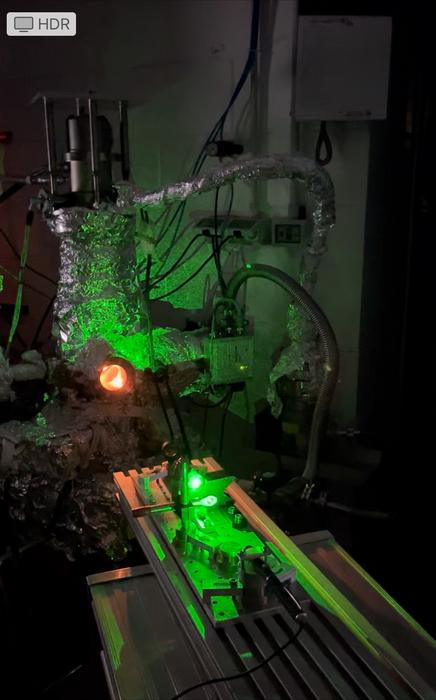
To validate the efficiency gains and material stability conferred by TEMPO bulk passivation, the research team employed positron annihilation spectroscopy, a cutting-edge characterization technique that utilizes antimatter particles to detect vacancy-type defects within the crystal structure. The results revealed a marked reduction in vacancy concentrations post-treatment, correlating directly with the observed boost in photovoltaic performance. This insight underscores the intimate link between microscopic defect engineering and macroscopic device functionality, highlighting a pathway for future defect-targeting innovations.
Moreover, the durability of these solar cells under practical operating conditions represents a critical achievement. Many perovskite devices suffer from rapid degradation when subjected to continuous illumination and elevated temperatures, thwarting their potential for commercial use. By contrast, the TEMPO-passivated cells maintained stable performance for several months, an unprecedented feat that reinforces the material’s readiness for real-world applications. This endurance not only enhances user confidence but also alleviates concerns related to maintenance costs and lifespan expectations.
The scientific community has long grappled with balancing efficiency gains and operational longevity in perovskite solar cells, often forced to compromise one attribute for the other. This newfound bulk passivation method disrupts this trade-off paradigm by simultaneously advancing both critical parameters. The rapid-annealed films deliver robust photovoltaic conversion efficiencies while resisting the formation and propagation of defect-induced degradation pathways. This dual success is expected to accelerate the commercialization timeline for perovskite-based solar technologies considerably.
From a mechanistic standpoint, the TEMPO molecule’s stable radical nature enables it to act as an electron spin trap, neutralizing charge carriers that could otherwise contribute to defect formation and recombination losses. This phenomenon, combined with the instantaneous thermal activation via infrared pulses, facilitates a defect healing process that was previously unattainable under conventional conditions. Such precise defect engineering exemplifies the sophisticated interplay between chemistry, materials science, and applied physics driving next-generation solar cell innovation.
Industrial stakeholders are particularly enthused by the implications of this research, given the compatibility of the process with existing photovoltaic manufacturing lines. The ability to retrofit production facilities with minimal infrastructural overhaul lowers entry barriers and accelerates technology transfer from research laboratories to market-ready products. Significantly, the concise annealing duration drastically reduces cycle times and manufacturing overhead, potentially leading to higher throughput and lower overall costs.
In terms of environmental impact, the solvent-free nature of the bulk passivation technique is an added advantage, mitigating concerns associated with toxic solvents and hazardous waste—a common issue in many material processing methods. Furthermore, the lightweight and flexible properties of the resulting solar sheets encourage their adoption in diverse sectors, from architectural integration in smart buildings to powering autonomous wearable gadgets, all contributing to decentralized and sustainable energy generation.
Looking ahead, the research community is eager to explore how this bulk passivation strategy can be generalized to other perovskite formulations and multi-junction solar architectures. The principles underpinning TEMPO’s defect passivation efficacy and ultrafast annealing could catalyze a broader paradigm shift in thin-film photovoltaics, ultimately narrowing the performance gap between perovskites and established silicon-based technologies.
In summary, this study not only offers a compelling solution to the perennial challenges of efficiency and stability in perovskite solar cells but also brings us closer to realizing affordable, durable, and versatile solar energy harvesting systems. As climate change demands rapid deployment of clean energy technologies, innovations like TEMPO bulk passivation will be pivotal in driving the global transition towards a sustainable energy future.
Subject of Research:
Not applicable
Article Title:
TEMPO bulk passivation boosts the performance and operational stability of rapid-annealed FAPI perovskite solar cells
News Publication Date:
May 22, 2025
Web References:
http://dx.doi.org/10.1016/j.joule.2025.101972
Image Credits:
Politecnico di Milano
Keywords
Solar energy, Perovskites, Applied physics, Energy resources, Industrial science
NIH Scientists Evaluate Surgical Technique in Animal Models to Enhance Cell Therapy for Dry AMD
Next PostPromising New Combination Therapy Demonstrated as Safe and Feasible for Neuroendocrine Tumor Patients
Related Posts

Quantum Sensors Built to Withstand Extreme Pressures
Princeton Chemistry’s Hammes-Schiffer Unveils First-Principles Method for Molecular Polaritons
Smoking or Vaping Could Elevate Your Risk of Developing Diabetes, New Study Finds
Metasurface Revolutionizes Atomic Magnetometers with Enhanced Compactness and Sensitivity
New Study Highlights the Promise of Collagen-Based Micro/Nanogels in Medical Applications