
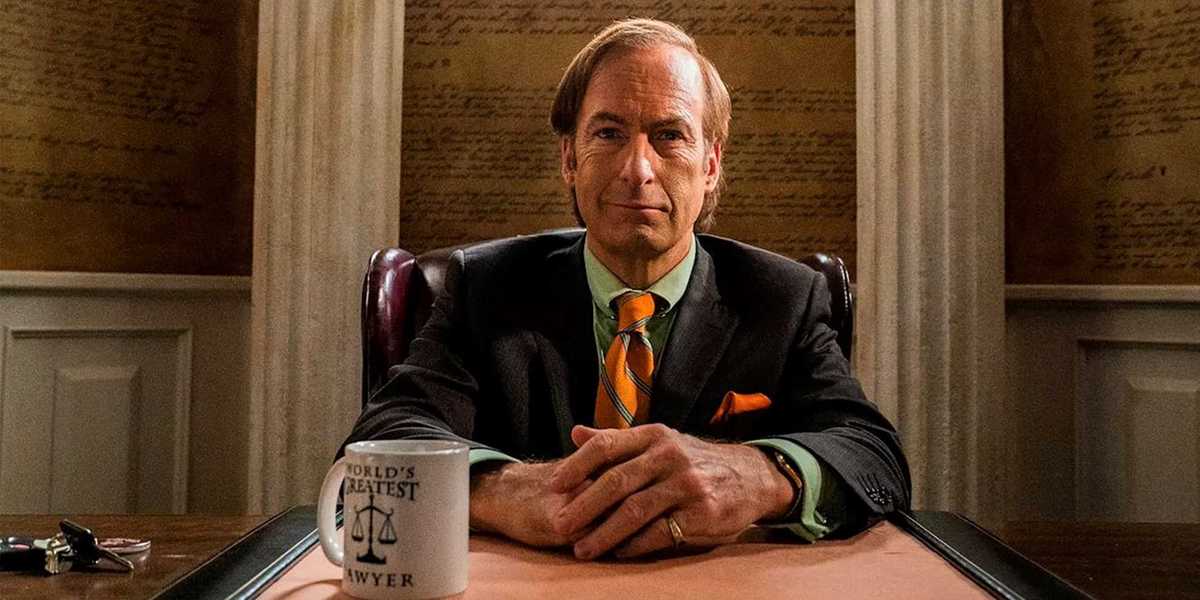
The Real Jimmy McGill Only Appeared In 1 Episode Of Breaking Bad
For most of Breaking Bad’s run, Walter White’s lawyer hid behind his carefully cultivated Saul Goodman persona; he only returned to his true identity as Jimmy McGill in one episode. Bob Odenkirk first debuted the character of Saul in Breaking Bad season 2, episode 8, “Better Call Saul.” After Badger was arrested for selling Walt and Jesse’s product, Jesse insisted that they didn’t need a criminal lawyer; they needed a *criminal* lawyer, so they recruited Saul’s unscrupulous services. Saul ended up serving as Walt and Jesse’s lawyer and money-laundering consultant for the rest of the series.
After Breaking Bad ended and Saul got his own spinoff, Better Call Saul, it became apparent that “Saul” was just an act he’d been putting on in front of Walt and his other clients. He’s really a vulnerable underdog named Jimmy who was driven to play a corrupt character after being undervalued by his brother and abandoned by the love of his life. Despite his flamboyance, Saul is a reprehensible monster; Jimmy is a sympathetic human being. In retrospect, Jimmy only emerged from behind the mask of Saul in one episode of Breaking Bad.
Bob Odenkirk's Final Breaking Bad Scene Is Where Jimmy McGill Appears
Jimmy Drops The Saul Act After Recruiting The Services Of The Disappearer
When Walt’s criminal empire starts to collapse, he brings Saul down with it. At the beginning of season 5, episode 15, “Granite State,” Saul races to the vacuum store owned by “disappearer” Ed Galbraith and gives him a truckload of cash to give him a new identity and relocate him to another state. Much to Saul’s chagrin, while he’s waiting for Ed to sort out the documents and find him a place to live, he’ll have to stay with a roommate: Mr. White himself. While they’re laying low in Ed’s basement, Walt’s lawyer finally drops the Saul act.
"Granite State" was written and directed by future Better Call Saul showrunner Peter Gould.
This is where Saul reveals who he really is: a regular guy who got mixed in with the wrong crowd, tried to go straight, got rejected by the right crowd, and doubled down on his association with the wrong crowd. Walt tries to coerce Jimmy into coming with him, but Jimmy is no longer intimidated by the legendary Heisenberg. Rather than dancing around the situation with his usual verbal eccentricity, Jimmy gives it to Walt straight: their criminal activities are over, and if they’re lucky, their best-case scenario will be a boring, mundane, uneventful life in hiding.
Better Call Saul Completely Changed How You Look At Saul In Breaking Bad
Better Call Saul Explored The Human Being Behind The Mask

All throughout Breaking Bad, Saul served primarily as comic relief. There were hints at his backstory and motivations, but no real dramatic exploration of them. Through his contacts and connections, Saul facilitated plot points like Walt’s money-laundering scheme and the poisoning of Brock. But he was mainly there to make the audience laugh with his quippy one-liners and peculiar behavior. Then, Better Call Saul brought a lot more depth to the character. By the end of Better Call Saul, Saul had evolved into every bit the complex, three-dimensional, near-Shakespearean tragic hero that Walt was in the original series.
By the end of Better Call Saul, Saul had evolved into every bit the complex, three-dimensional, near-Shakespearean tragic hero that Walt was in the original series.
And after watching Better Call Saul, the character plays a lot differently on a rewatch of Breaking Bad. Saul’s tacky TV ads hit differently, because a miserable, aging Saul will one day watch those ads through a nostalgic lens — they’ll be his only remaining connection to his exciting former life. All of Saul’s quips about his ex-wife hit differently after watching Better Call Saul, because he was devastated when Kim Wexler left him; that’s what pushed him over the edge to close off his emotions and adopt the Saul persona full-time.
Saul Had Already Become A More Complex Character By The End Of Breaking Bad
It Was Obvious That "Saul Goodman" Was Just An Act

When Saul was introduced in Breaking Bad season 2, he was purely a comic-relief figure. By the end of the series, comic relief was still his primary function, but he’d also become a much more complex character. Even without all the backstory that would eventually be revealed in Better Call Saul, Breaking Bad viewers could already tell that “Saul Goodman” was just a mask being worn by a vulnerable human being — especially when Saul was in distress. If his life was in danger, he would drop that mask in a second and beg for mercy.
In Breaking Bad season 5, episode 1, “Live Free or Die,” it’s clear that there’s more to Saul than meets the eye. When Walt squares up to Saul in his office and menacingly tells him, “We’re done when I say we’re done,” Saul is terrified; he doesn’t know what this drug lord — who’s proven he isn’t above poisoning a child — will do to him. It was apparent that Saul was a facade, and that there was a lot more unseen depth to this character. Better Call Saul took that setup and ran with it.
Better Call Saul's Finale Brought It All Full Circle With A "Granite State" Flashback
The Final Episode Of Better Call Saul Went Back To Saul's Breaking Bad Ending

Better Call Saul brought Saul’s journey full circle in its final episode: season 6, episode 13, “Saul Gone.” The episode didn’t just act as an ending for Better Call Saul itself; it was an ending for the entire Breaking Bad universe. It jumped all over the story timeline for a definitive conclusion to both Jimmy’s character arc and the overall narrative. Jimmy blew his cover in Omaha and Marie Schrader came back for justice. The finale went back to Saul’s stay with Walt in Ed’s basement during the events of “Granite State.”
The Better Call Saul finale, "Saul Gone," originally aired on AMC on August 15, 2022.
As they try to kill the time, Jimmy asks Walt what he would do if he could use a time machine. Walt initially mocks the question, but eventually answers that he would stop himself from pulling out of Gray Matter Technologies. Jimmy tells Walt that he regrets injuring his knee during a childhood scam. Upon hearing that he was pulling scams as a kid, Walt condescendingly tells Jimmy, “So, you were always like this.” Therein lies the key difference between Walt and Jimmy: Walt transformed into a murderous monster, but Jimmy was always a conman.
Therein lies the key difference between Walt and Jimmy: Walt transformed into a murderous monster, but Jimmy was always a conman.
This scene in the Better Call Saul finale brought the entire Breaking Bad saga full circle. It went back to Jimmy’s final scene from Breaking Bad — his final interaction with Walt — and highlighted the crucial difference between the franchise’s two central antiheroes. “Granite State” was the first time audiences got to see the real Jimmy McGill, and the last time audiences saw the character, he went back to that moment.

Breaking Bad

- Release Date
- 2008 - 2013-00-00
- Network
- AMC
- Showrunner
- Vince Gilligan
- Directors
- Vince Gilligan, Michelle Maclaren
- Writers
- Peter Gould, Gennifer Hutchison, Vince Gilligan, George Mastras, Moira Walley-Beckett, Sam Catlin, Thomas Schnauz
Cast
 Walter White
 Jesse Pinkman
Breaking Bad, created by Vince Gilligan, follows a chemistry teacher turned drug kingpin named Walter White (Bryan Cranston) as he attempts to provide for his family following a fatal diagnosis. With nothing left to fear, White ascends to power in the world of drugs and crime, transforming the simple family man into someone known only as Heisenberg.
- Seasons
- 5







Your comment has not been saved