UCC Scientists Pioneer Innovative Quantum Visualization Method to Discover Materials for Next-Generation Quantum Computing
UCC Scientists Pioneer Innovative Quantum Visualization Method to Discover Materials for Next-Generation Quantum Computing
Scientists at University College Cork (UCC), Ireland, have pioneered a groundbreaking advancement poised to revolutionize the search for materials suitable for next-generation quantum computing technologies. Their research offers the first conclusive method to determine whether a material can inherently function as a topological superconductor—an essential component for building fault-tolerant quantum microchips. This breakthrough, published in the prestigious journal Science, marks a transformative moment in material science and quantum physics.
The quest to identify intrinsic topological superconductors has challenged physicists for decades. These unique materials exhibit exotic surface states that host Majorana fermions—quasi-particles theorized to encode quantum information in a manner inherently resistant to environmental disturbances. While many candidate materials have been proposed, none have conclusively satisfied all the strict criteria to be classified as intrinsic topological superconductors. Now, the team at UCC, leveraging an innovative experimental approach, has decisively evaluated one of the most promising candidates: Uranium ditelluride (UTe₂).
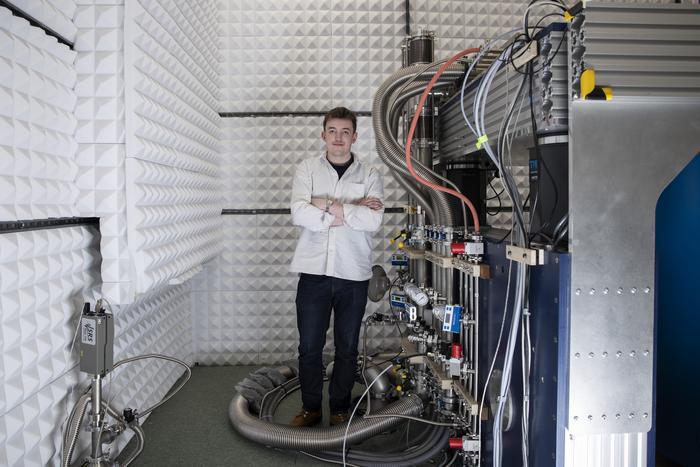
UTe₂, discovered in 2019, rapidly garnered scientific attention for its superconducting and possibly topological properties. Traditional experimental techniques were insufficient to unravel the complexities of this material’s electronic and quantum states. To address these limitations, Professor Séamus Davis of UCC, an expert in quantum physics, developed a novel “Andreev” scanning tunneling microscopy (STM) mode. This technology, available exclusively in three laboratories worldwide—including UCC, Oxford University, and Cornell University—enabled the team to peer beneath the electronic “noise” and directly observe the characteristics indicative of topological superconductivity.
Applying this espionage-like tool, PhD researcher Joe Carroll and Marie Curie postdoctoral fellow Kuanysh Zhussupbekov spearheaded the investigations into UTe₂’s surface states. Unlike conventional STM, which uses metallic probes that inevitably mix signals from trivial surface electrons, the Andreev STM employs a superconducting tip. This methodology filters out the normal electron contributions, isolating the signature of Majorana fermions. The precision of this technique permitted an unprecedented, unequivocal assessment of whether UTe₂ embodies intrinsic topological superconductivity.
The findings revealed that UTe₂ indeed operates as an intrinsic topological superconductor. Yet, intriguingly, it does not conform precisely to the archetype physicists had long sought. Instead, the material’s superconducting and topological wave functions exhibit a more nuanced symmetry and complexity, expanding the conceptual landscape of what qualifies as an intrinsic topological superconductor. These insights deepen the understanding of superconductivity’s quantum mechanical foundations and open new avenues for material synthesis aimed at optimizing quantum information applications.
Professor Davis emphasized the novelty of the approach by explaining that previous techniques relied heavily on metallic probes that contributed extraneous electron signatures, complicating data interpretation. By contrast, this superconductor-based STM eradicates the confounding background electrons, enabling a “pure” visualization of the zero-energy surface states where Majorana modes reside. This purity is critical because these Majorana fermions are theorized to enable quantum bits (qubits) to maintain coherence far longer than conventional systems, a holy grail for quantum computing.
The implications for the quantum computing industry are profound. As global efforts intensify to build scalable quantum processors, the challenges of qubit decoherence and error correction remain formidable obstacles. Synthetic topological superconductors, composed of engineered stacks of conventional materials, have shown promise but introduce complexity and scalability concerns. The UCC team’s demonstration that a single, intrinsic material like UTe₂ can host the requisite topological states hints at the potential to simplify quantum processor architectures significantly.
This breakthrough aligns with initiatives such as Microsoft’s Majorana 1 chip, the world’s first quantum processing unit driven by a topological core using synthetic superconductors. The Davis Group’s methodology offers an alternative strategy—one that could replace engineered heterostructures with straightforward single-crystal materials, reducing fabrication complexity and enhancing qubit density on chips. The ability to incorporate more qubits without proportionally increasing error rates is vital for the realization of practical quantum algorithms capable of tackling classically intractable problems.
Moreover, the use of Andreev STM as a diagnostic instrument transcends the immediate focus on UTe₂. It equips researchers with a universal probe capable of validating other candidate superconductors’ topological nature. This technological leap empowers the scientific community to systematically filter and identify materials with intrinsic topological superconductivity from a vast chemical universe, accelerating discovery cycles and guiding theoretical modeling.
In addition to its technical contributions, this research exemplifies international collaboration’s role in advancing quantum materials science. Input from distinguished theoretical physicist Prof. Dung-Hai Lee (UC Berkeley) and materials synthesis experts from Washington University and the University of Maryland enriched the study’s multidisciplinary depth, ensuring a comprehensive approach bridging theory and experiment.
While UTe₂’s exact topological superconductor class may differ from classic expectations, its confirmation as an intrinsic platform hosting Majorana modes represents an essential puzzle piece in the quantum computing saga. The work sets a new standard for experimental rigor and innovation, marking a hopeful trajectory toward building quantum processors that transcend today’s limitations on coherence time, qubit number, and error rates.
In sum, the Davis Group’s pioneering use of Andreev STM to visualize zero-energy surface states in UTe₂ is more than a scientific milestone—it heralds a new era in material exploration tailored for quantum technologies. Their findings cast light on the subtle symmetries governing superconductivity’s quantum phases and unlock practical pathways toward scalable, fault-tolerant quantum computing hardware. As the quantum race accelerates, such breakthroughs bridge the gaps between fundamental physics, material engineering, and the computational revolutions of tomorrow.
Subject of Research: Quantum materials; intrinsic topological superconductivity; Majorana fermions; Uranium ditelluride (UTe₂); scanning tunneling microscopy (STM) techniques.
Article Title: Pair wave function symmetry in UTe₂ from zero-energy surface-state visualization
News Publication Date: 29-May-2025
Web References: http://dx.doi.org/10.1126/science.adk7219
Image Credits: Clare Keogh (University College Cork)
Ancient Tooth Enamel Proteins Uncover Hidden Diversity in African Paranthropus
Next PostNew Study Explores Informal Educators’ Confidence in Inspiring Youth Environmental Civic Engagement
Related Posts

Exploring Acupuncture as a Treatment for Chronic Low Back Pain in Older Adults
UT San Antonio Unveils New College of AI, Cybersecurity, and Computing
Ohio State Researchers Propel Nuclear Propulsion Technology Forward
Ringing Black Hole Validates Predictions by Einstein and Hawking
Quantum Processor Unlocks Exotic Phase of Matter