Why Are Eastern Trails So Steep, When the West Loves Switchbacks?
Hiking is a sport without teams, but if there is any rivalry that dominates the scene, it is the everlasting debate of whose trails are more difficult: the East or the West. Most of this plays out in online forums and Instagram comments, where Easterners tease Westerners as “switchback princesses,” and Westerners laconically dismiss the low, rolling peaks of the East as not worth their time.
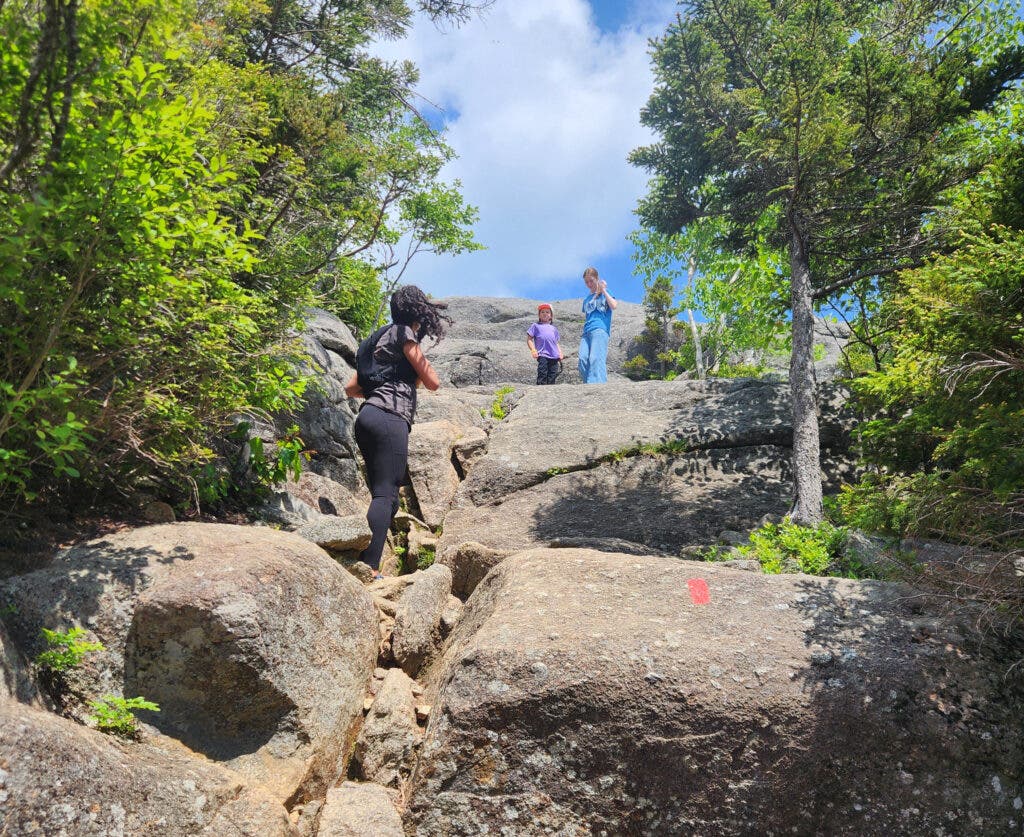
While the mountains in the East—the Adirondacks, the Appalachians, and their various sub-ranges—are relatively low elevation compared to the Rockies and Sierras, the trails ascending these modest peaks are steep, sometimes comically so. Anyone who has hiked in the East—especially in the Northeast—can remember scrambling up wet gullies, grabbing rocks and roots to steady themselves. In the thru-hiking community, it is a well-known fact that the AT, while shorter in length and lower in elevation than the PCT and CDT, has the most elevation gain per mile of the Triple Crowners.
How did these topographically mellow peaks in the East end up with such heinously vertical routes, while gargantuan Western mountains feature gentle switchbacking climbs? To understand this, allow me to introduce the three P’s: private property, pack stock, and pride.
In the mid-1800s, Americans came around to the idea that wilderness had a kind of spiritual value, an idea that blossomed in the industrialized, grimy cities of the Northeast. Fatigued with hustle-bustle and filth, well-heeled New Yorkers and Bostonians started heading into the mountains, and entrepreneurial hoteliers in the Catskills, White Mountains, and Adirondacks opened mountain lodges to greet them. Guests, inspired by Transcendentalist voices such as Emerson and Whitman, clamored for short, meditative walks from their cozy resorts. Lodge owners, limited by private property lines and short on manpower, cut primitive, direct trails to nearby peaks and scenic overlooks for their guests to enjoy. Thus began the legacy of steep trails in the Northeast. These early trails were mostly out-and-back scrambles accessible only to lodge guests, but as trailbuilding expanded in the region, many of these heritage routes were incorporated into the larger systems we see today.
While Northeastern urbanites were taking poetically inspired forays into nearby wilds, the Rockies and Sierras were still a true frontier. Mining, grazing, and hunting lured droves of settlers into the lofty peaks, their intrusions displacing Native communities who had retreated to some of these final pockets of not-yet-colonized territory. Vast distances and a need to carry heavy supplies and spoils meant that pack stock—donkeys, mules, and horses—were the primary means of transportation. Contoured, switchbacking trails friendly to a loaded mule became the standard, and that standard has persisted today in the West.
So why did the Northeasterners continue to build steep trails, even as other regions adopted switchbacks? That brings us to our last P: pride. Consider J. Rayner Edmands, a prolific White Mountain trailbuilder who traveled to the Rockies in the late 1800s and was inspired by the graded trails he saw there. He returned to New Hampshire and started cutting trails in the Western style, “always rising, but never steeply,” as described by a commemorative plaque on his namesake col in the Whites.
The thing is, people didn’t—and still don’t, it seems—like Edmands’ trails very much. They considered them too easy. In Forest and Crag: A History of Hiking, Trailblazing, and Adventure in the Northeast Mountains, historians Laura and Guy Waterman describe how contemporaries considered his trails “boulevards,” and the people who walked them resembled a “transplanted tea party.” Later generations of trailbuilders in the region generally ignored his style, preferring to build in the steep tradition.
Edmands may have had the last laugh. It turns out that contoured trails manage water better and have fewer problems with erosion. Today, trailbuilders in the Northeast have the monumental task of hardening old trails with stonework to prevent erosion, and nearly all new trails and re-routes are planned in the more sustainable, Western style.
Hikers from coast to coast will continue to debate who has the harder trails. But perhaps a better question is: which style is more fun? My friend and fellow trailbuilder, Sam Walters, put it like this: “Fun in the Northeast means hard. Fun in the West means big.” “Fun” is a rather squishy term in an activity that celebrates hardship and discomfort. Whether your definition of “fun” is a scramble through a lush ravine or a stroll at 13,000 feet is ultimately a matter of preference, or for some, pride.